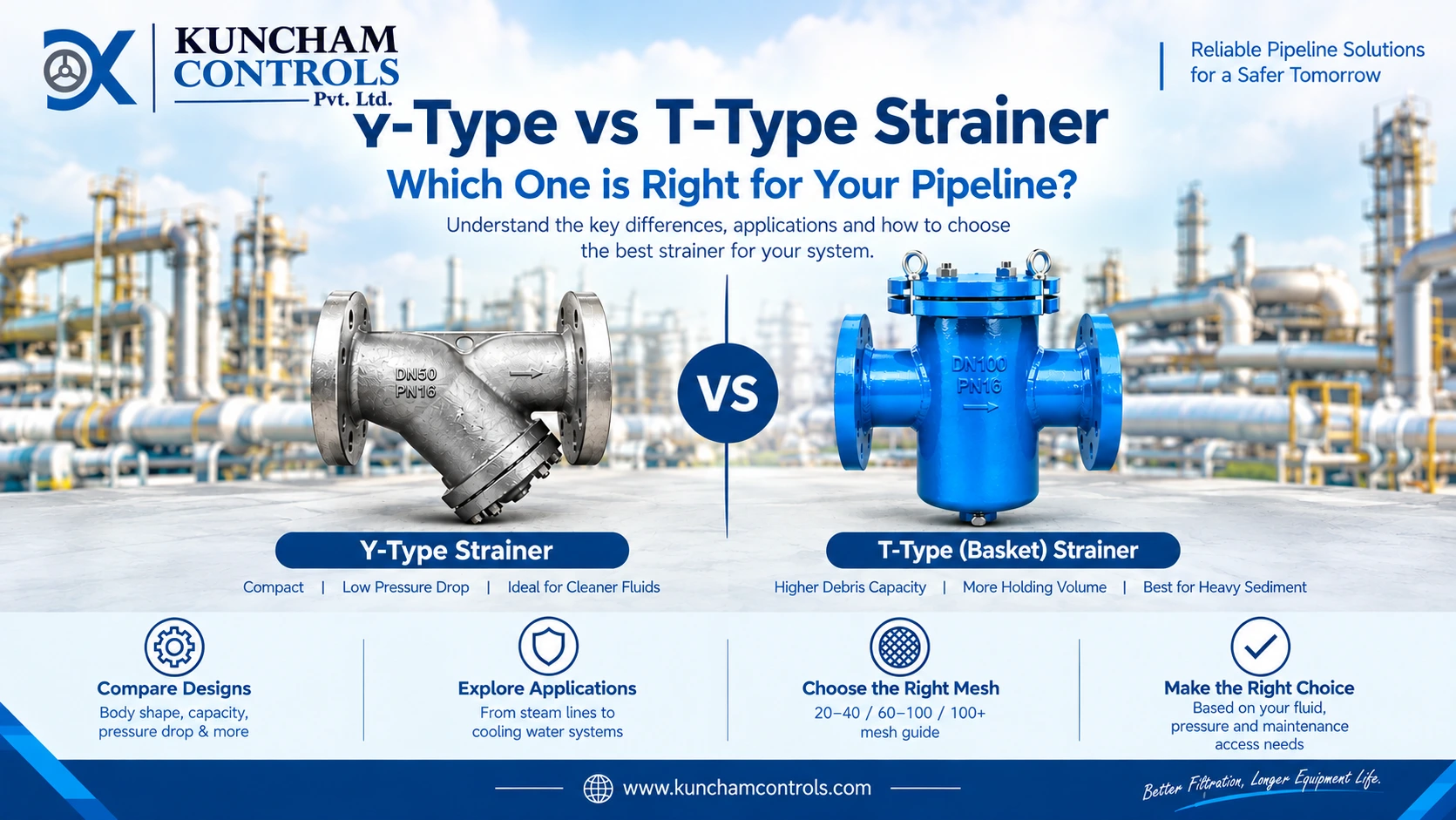
The main difference between a Y-type and a T-type strainer comes down to body shape and how much debris each one can hold before it needs cleaning. A Y-strainer uses a compact, angled body that sits inline with minimal pressure drop, while a T-strainer — often built as a basket strainer — uses a larger vertical chamber that traps far more sediment before flow suffers.
If you're specifying pipeline strainer types for a new install, or you're troubleshooting recurring clogs on an existing line, that single distinction — body geometry versus holding capacity — decides almost everything else: cleaning frequency, orientation limits, and cost. This guide walks through both designs, where each one earns its keep, and how to pick between them without over-engineering your debris filtration pipeline.
What Is a Y-Type Strainer?
A Y-strainer gets its name from the shape of the body. Picture the letter Y lying on its side, with a branch pipe angled off the main flow line at roughly 45 degrees. Inside that angled pocket sits a removable perforated or mesh screen that catches particles as fluid passes through.
Because the screen sits off to one side rather than dead center, a Y-strainer keeps a straighter flow path than most basket designs — which is part of why plant engineers reach for it on high-pressure or high-velocity lines. You'll usually find a threaded cap or bolted cover at the end of the branch, and that's where the screen slides out for cleaning.
Where the Design Shines
• Compact footprint that fits into tight piping runs
• Lower pressure drop compared with basket-style units
• Available in cast iron, bronze, stainless steel, and PVC to suit different media
What Is a T-Type Strainer?
Flip that logic around and you get the T-strainer, sometimes called a basket strainer because the screen sits inside a much larger chamber shaped like an upside-down T or a pot. Instead of a small angled pocket, the basket occupies a full vertical branch — and that extra volume is the whole point.
More surface area means more room for sediment before flow gets choked off, so the T-strainer is usually the go-to wherever debris loads are heavy or unpredictable: think cooling water intakes, tank bottoms, or lines carrying pulp, scale, or construction-grade water.
Basket Construction Basics
• Removable basket lifts straight out through a top or side cover
• Baskets range from coarse perforated plate to fine wire mesh
• Larger units often include a differential pressure gauge to flag when cleaning is due
Y-Type vs T-Type Strainer: Key Differences
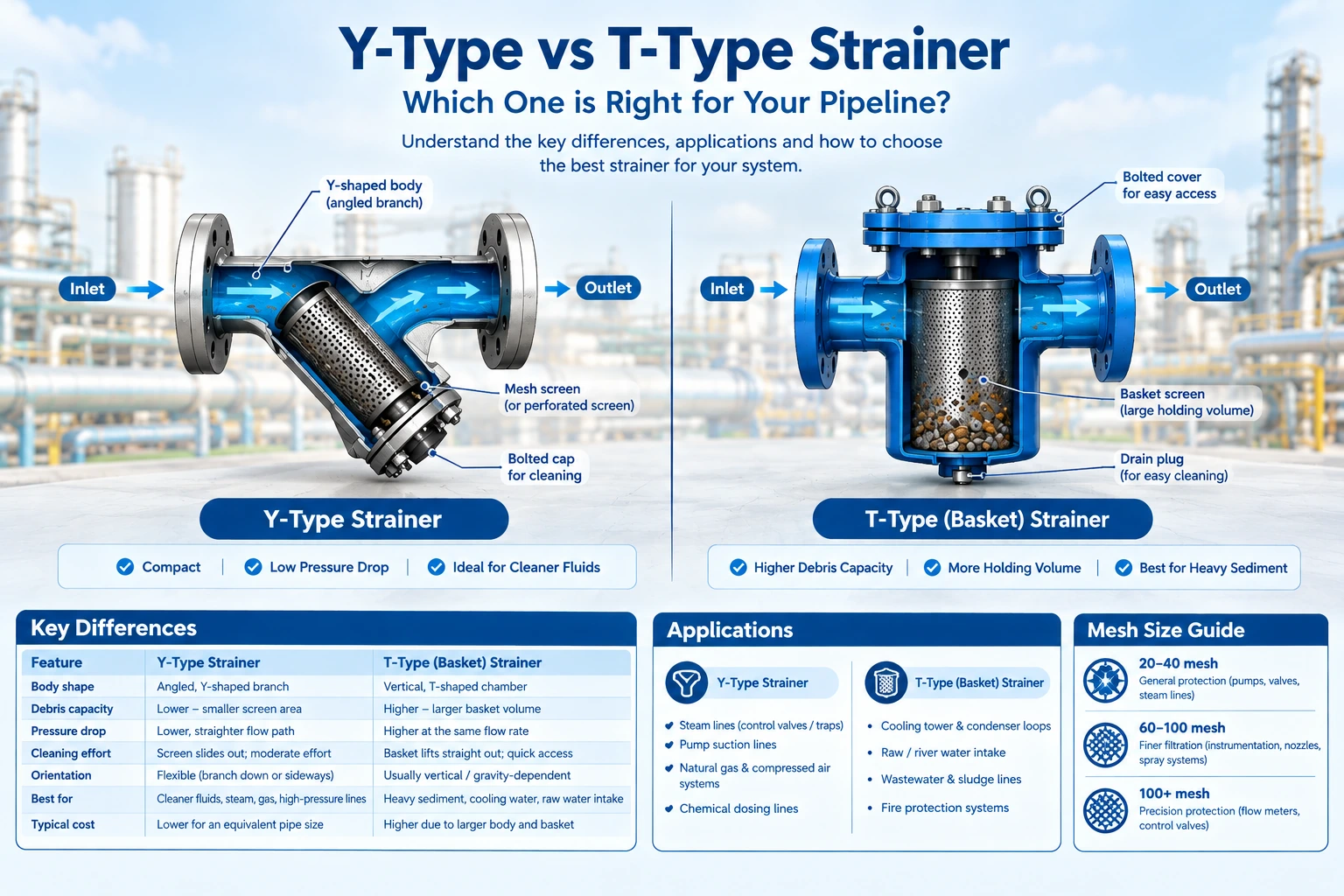
Here's where the comparison earns its keep. Both strainers filter debris out of a liquid or gas stream, but they solve different problems — and the table below breaks down exactly where they part ways.
Feature | Y-Type Strainer | T-Type (Basket) Strainer |
Body shape | Angled, Y-shaped branch | Vertical, T-shaped basket chamber |
Debris capacity | Lower - smaller screen area | Higher - larger basket volume |
Pressure drop | Lower, straighter flow path | Higher at the same flow rate |
Cleaning effort | Screen slides out; moderate effort | Basket lifts straight out; quick access |
Orientation | Flexible, with the branch pointing down or sideways | Usually vertical / gravity-dependent |
Best for | Cleaner fluids, steam, gas, high-pressure lines | Heavy sediment, cooling water, raw water intake |
Typical cost | Lower for an equivalent pipe size | Higher due to larger body and basket |
The short version: if your line runs relatively clean and pressure drop matters, lean Y-type. If you're dealing with heavy sediment and don't want to be at the strainer every shift, lean T-type. A flow-lab study by the Korea Research Institute of Standards and Science tested a Y-type strainer against a straight-through design and found the straight-through unit had a higher flow capacity, which is why pressure drop deserves attention when you choose a body style.”
Y Strainer Application: Where It Works Best
• Steam lines ahead of control valves or steam traps
• Pump suction lines, protecting impellers from weld slag or pipe scale
• Natural gas and compressed air systems
• Chemical dosing lines where fluid is relatively clean but still needs a final polish
Steam system manufacturers such as Spirax Sarco also recommend fitting a Y-type strainer before steam traps, so dirt does not enter the trap. Plenty of pump manufacturers actually specify a Y-strainer with a 20-mesh screen directly ahead of a centrifugal pump's suction to protect wear rings and seals. Skip it, and you're often looking at premature seal failure a few months down the line.
T Strainer Application: Where It Works Best
• Cooling tower and condenser water loops
• Raw or river water intake ahead of treatment
• Wastewater and process lines carrying sludge or fibrous material
• Fire protection systems, where basket strainers are standard because they trap large debris without needing constant attention
A basket strainer fitted with a 40-mesh screen ahead of a plate heat exchanger keeps sediment out of the exchanger's narrow flow channels — and that matters, because even a small clog there can tank thermal efficiency fast.
Strainer Mesh Size: Getting It Right
Mesh size decides what actually gets stopped, and getting it wrong causes two very different failure modes: too coarse, and fine particles pass straight through to damage downstream equipment; too fine, and the screen clogs constantly, pulling your team back to the strainer every shift.
General Mesh Guide
• 20–40 mesh: general-purpose protection for pumps, valves, and steam lines
• 60–100 mesh: finer filtration ahead of instrumentation, nozzles, or spray systems
• 100+ mesh: precision protection for sensitive equipment like flow switches, pressure transmitters, or control valves”
A reasonable rule of thumb: match the mesh opening to roughly half the smallest clearance in the equipment you're protecting downstream. [Link to related post] on selecting strainer mesh for pump protection has a deeper breakdown if you want to dial this in further.
Which One Should You Choose for Your Pipeline?
Ask yourself three questions before you spec anything:
1. How dirty is the fluid? Heavy sediment points you toward a T-type/basket strainer; relatively clean fluid points you toward a Y-type.
2. How much pressure drop can you afford? If the budget for pressure drop is tight, the Y-type usually wins.
3. How often can someone realistically clean it? Infrequent access favors the T-type, since it holds more debris before it needs attention.
Still unsure? Oversizing the strainer body by one pipe size on either design buys you longer intervals between cleanings without hurting flow much — a trick used often on high-uptime lines that are hard to reach.
For technical background on strainer selection standards, ASME's piping guidelines are a solid external reference to cross-check against your project specs.
Final Takeaway
Picking between a Y-type vs T-type strainer isn't really about one being better — it's about matching the design to your debris load, pressure budget, and maintenance access. Clean, high-pressure lines lean Y-type; heavy sediment and hard-to-reach lines lean T-type/basket. Get that match right at the design stage, and you'll spend far less time chasing clogged screens later.
Need help specifying the right strainer, mesh size, or material for your exact pipeline? [Link to related post] on strainer sizing calculations, or reach out with your line specs and we'll help you narrow it down.
FAQ
What is the main difference between a Y-type and a T-type strainer?
The main difference is body shape and capacity. A Y-strainer uses a compact, angled branch with a smaller screen and lower pressure drop, while a T-strainer uses a larger vertical basket chamber that holds more debris before cleaning is needed.
Which strainer is easier to clean, Y-type or T-type?
A T-type basket strainer is generally easier and faster to clean since the basket lifts straight out through a top or side cover, whereas a Y-strainer's screen sits in an angled pocket that takes a bit more effort to access and reseat.
Can a Y-type strainer be installed in any pipe orientation?
Most Y-strainers can be installed horizontally, vertically, or at an angle, but the branch where the screen sits should point downward or to the side — never straight up — so debris settles into the screen instead of the pipe.
What mesh size should I choose for my strainer?
Mesh size depends on what you're protecting: 20–40 mesh works for general pump and valve protection, 60–100 mesh suits finer filtration ahead of nozzles or instrumentation, and anything above 100 mesh is for precision equipment. As a rule, match the opening to about half the smallest downstream clearance.
How often should a pipeline strainer be cleaned?
Cleaning frequency depends on debris load and mesh size, but a good practice is to monitor differential pressure and clean once it rises 3–5 psi above baseline, rather than sticking to a fixed calendar schedule.