To select a level measurement instrument, match the technology to three things: your medium, your process conditions and the job the instrument has to do, whether that's an alarm or a continuous reading. Get those right and a long vendor catalogue shrinks to two or three realistic options.
Get one wrong and you'll be re-ordering in six months. Foam fools an ultrasonic sensor. Buildup chokes a pressure-based device. A switch gets installed where the control room needed a trend.
This buying guide walks you through the questions to settle first, the factors that decide the outcome, a technology comparison, industry-by-industry pointers and a seven-step process you can reuse on every tank, silo and sump.
Start With the Job: Alarm or Measurement?
Before you open a single data sheet, ask one thing. Do you need to know where the level is, or only whether it has reached a certain point? The answer splits the market in two.
Point level measurement: the yes/no answer
A level switch changes state when the medium reaches a set height. That's it. It's the right tool for high-high alarms, overfill protection and low-level pump cut-outs that stop a pump from running dry.
Common designs include vibrating fork, float, conductive and capacitance switches. They're simple, and simple is exactly what you want in a safety role.
Continuous level measurement: the full picture
A level transmitter reports level as an output signal, usually 4–20 mA with HART. You need one for inventory, control loops, batch dosing and trending. If someone in the control room asks "how much do we have?", a switch can't answer.
Level switch vs level transmitter: how to decide
• Choose a switch when the only decision is start, stop or alarm, or when you want an overfill safeguard that's independent of the control system.
• Choose a transmitter when you need inventory, control, trending or remote diagnostics.
• Choose both on critical tanks. A radar transmitter feeds the control system, and a separate vibrating fork wired to shutdown logic catches the day the transmitter or the operator lets you down.
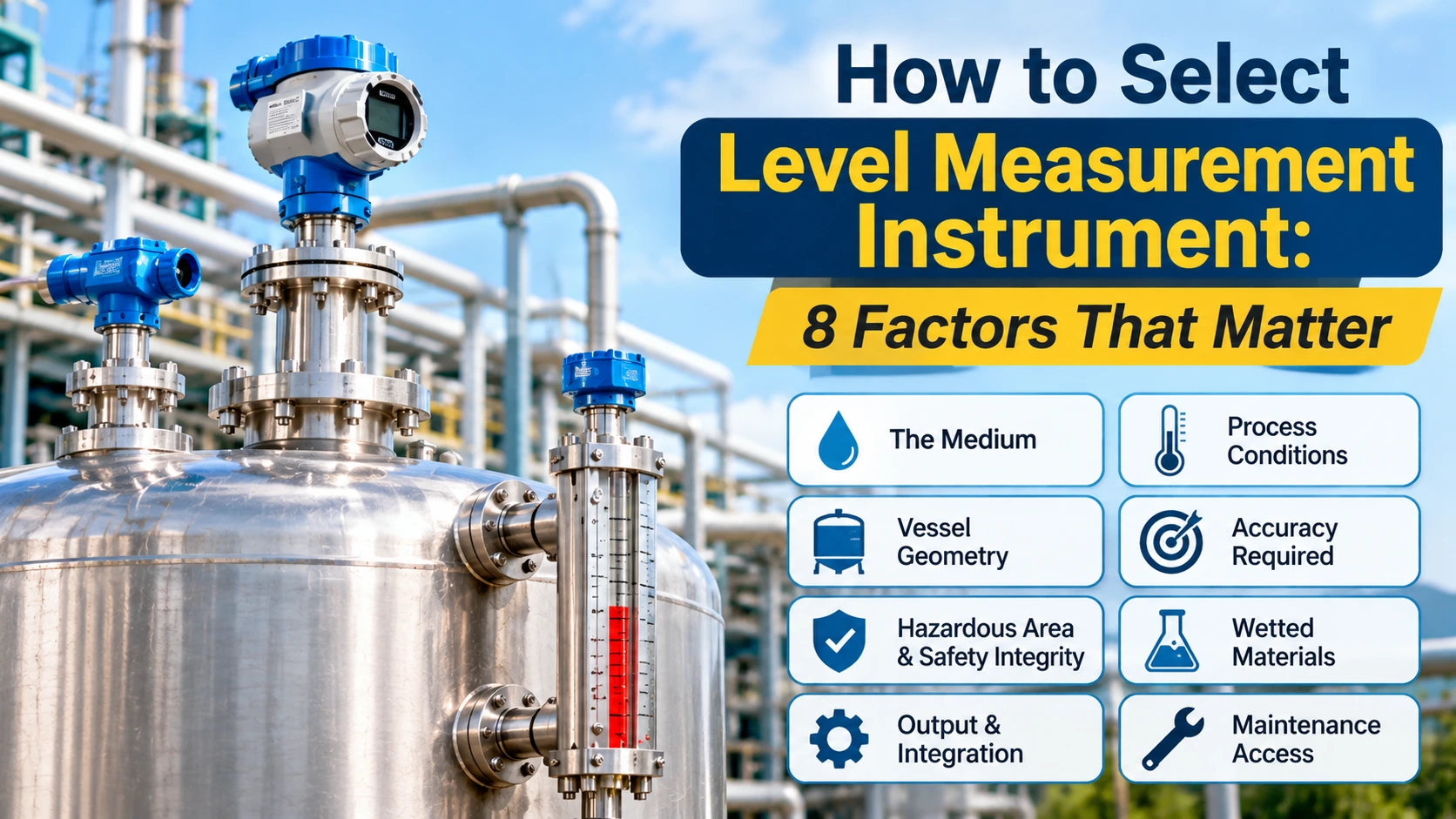
How to Select Level Measurement Instrument: 8 Factors That Matter
These are the questions that sink or save a specification. Work through them in order.
1. The medium. Is it a clean liquid, a slurry, a powder or two liquids stacked on each other? Note viscosity, conductivity, dielectric constant, foam, vapour and tendency to coat surfaces.
2. Process conditions. Record minimum and maximum temperature and pressure, including vacuum and cleaning cycles.
3. Vessel geometry. Height, nozzle size and internal obstructions such as agitators, ladders and heating coils all affect what will physically work.
4. Accuracy required. A custody-transfer tank and a utility sump don't deserve the same budget.
5. Hazardous area and safety integrity. Confirm the zone, gas group and any SIL target under IEC 61511 before shortlisting.
6. Wetted materials. Stainless 316L, Hastelloy, PTFE and PVDF each tolerate different chemicals. Check the actual chemistry, not the family name.
7. Output and integration. 4–20 mA with HART is common, but your plant may need Modbus, a fieldbus or wireless.
8. Maintenance access. Can you service or calibrate the device without emptying the vessel?
A quick example. A wastewater wet well foams and steams, so an ultrasonic sensor loses its echo for hours. Moving to a guided wave radar in a stilling well, or a submersible hydrostatic probe, solves it. Nothing about the sensor was "faulty." It was just wrong for the surface.
Level Measurement Technology Comparison
No technology wins everywhere. Here's how the main options compare when you strip away the brochure language.
Technology | Strengths | Watch out for |
Hydrostatic / differential pressure | Simple, economical, widely understood | Reading shifts with density; impulse lines can clog in dirty media |
Ultrasonic | Non-contact, cost-effective for open tanks and sumps | Foam, vapour, dust and turbulence distort the echo |
Guided wave radar | Unaffected by density changes; handles vapour; can detect interfaces | Probe buildup; long probes need support in agitated vessels |
Non-contact radar | Wide temperature and pressure range; suits liquids and solids | Needs a clear view; very low-dielectric media need a careful check |
Magnetic level indicator + transmitter | Local visual indication; dependable at high pressure | Float behaviour changes with density; sticky media can jam it |
Capacitance / RF admittance | Compact; copes with coating and interfaces | Must be calibrated against the real medium |
Vibrating fork (point) | Works in a wide range of liquids, including viscous ones; few moving parts | Point detection only |
Nuclear (gamma) | Non-invasive, for extreme conditions | Licensing, regulation and cost; a last resort |
Contact or non-contact?
Go non-contact when the medium is corrosive, sticky or hygienic. Go contact when the vessel is narrow, cluttered with internals or foams heavily. Radar technology has made the gap smaller, but the question is still worth asking on every tag.
Matching Level Instruments to Your Industry
Water and wastewater
Ultrasonic sensors dominate open channels and clean sumps. Submersible hydrostatic probes work well in wells. Where foam, grease or condensation is a problem, radar is the safer bet.
Chemical and petrochemical
Guided wave or non-contact radar with chemically resistant wetted parts is a common starting point. Add a vibrating fork for independent overfill protection. Ex certification isn't optional here.
Oil and gas
Radar gauging suits storage tanks, while differential pressure and guided wave radar are common on separators, including interface measurement. For atmospheric petroleum storage, overfill protection is covered by API 2350.
Food, beverage and pharma
Look for hygienic process connections such as tri-clamp, polished surfaces and designs that survive CIP and SIP cycles. Check relevant hygienic approvals like 3-A or EHEDG.
Power, cement and bulk solids
Dust and buildup rule here. Radar copes with dusty silos, and rotary paddle or vibrating rod switches handle point detection. Boiler drums, with their heat and pressure, call for specialist DP or guided wave radar setups.
Choosing Level Sensor Technology: Cost vs Reliability
Price tags mislead. The purchase price is often a small part of what an instrument costs over its life. Installation, wiring, calibration, false trips and unplanned shutdowns add up fast.
Count these before you compare quotes:
• Installation and commissioning effort
• Calibration frequency, and whether it needs a drained tank
• Cost of a false alarm or a missed one
• Spares, local support and lead time
• Certification and documentation for your area
A practical rule: put reliability first wherever failure means a spill, a safety incident or a stopped line. Save money on forgiving duties like a utility water sump.
Mistakes that show up again and again
• Picking what the plant used last time without checking the new medium.
• Ignoring foam, vapour or buildup because the process sheet didn't mention them.
• Specifying a measuring range far larger than the vessel needs.
• Skipping the dielectric constant check on radar and capacitance devices.
• Assuming one technology will cover every tank on site.
A Level Instrument Buying Guide: Seven Steps From Spec to Purchase Order
9. Define the purpose. Alarm, control, inventory or custody transfer.
10. Fill in a process data sheet. Medium properties, temperature, pressure and a vessel drawing.
11. Note the hazardous area and SIL needs.
12. Shortlist two or three technologies using the comparison above.
13. Test the shortlist against the supplier's application limits. Ask for an application review, not just a quote.
14. Compare total cost of ownership, not unit price.
15. Confirm certificates, outputs and spares before you raise the purchase order.
One habit helps more than any of the above. Send the supplier your complete process data sheet, not just a tag number. A good one will push back if your first choice doesn't suit your medium, and that pushback is free engineering.
How to Select Level Measurement Instrument: The Short Version
Pick for the process, not the brochure. Decide whether you need a switch, a transmitter or both, work through the eight factors, and let the comparison table narrow the field.
Treat how to select level measurement instrument as an engineering question first and a purchasing question second, and you'll avoid most expensive surprises. For the safety side, the IEC 61511 standard on the IEC website is the authority to check.
Got a tricky tank or an upcoming project? Send us your process data sheet and we'll help you shortlist the right technology. [Link to related post: flameproof vs weatherproof enclosure]
What factors should I consider when choosing a level measurement instrument?
Start with the medium, including its viscosity, foam, vapour and dielectric constant. Then consider process temperature and pressure, vessel geometry, accuracy needs, hazardous area requirements, wetted materials and output signal. Maintenance access matters too.
Should I choose a level switch or a level transmitter for my application?
Choose a switch if you only need an alarm or a start/stop signal at a fixed point. Choose a transmitter if you need continuous readings for control, inventory or trending. Many critical tanks use both, with the switch acting as an independent overfill safeguard.
How does the type of media affect instrument selection?
The medium decides which physical principle will work. Foam, vapour, buildup, low dielectric constant and changing density can all cause some technologies to read wrongly. Corrosive media also limit your choice of wetted materials.
Is cost the main factor to consider, or should reliability take priority?
Reliability should lead wherever failure risks safety, spills or lost production. Purchase price is only part of total cost, because calibration, downtime and false alarms add up. For forgiving, low-risk duties, a cheaper device is usually fine.
Can one instrument type work for multiple applications across my plant?
Sometimes, but rarely for every tank. Radar covers many liquid applications, yet interfaces, solids, hygienic duties and independent overfill protection often need different technologies. Standardising on a few types keeps spares and training manageable.