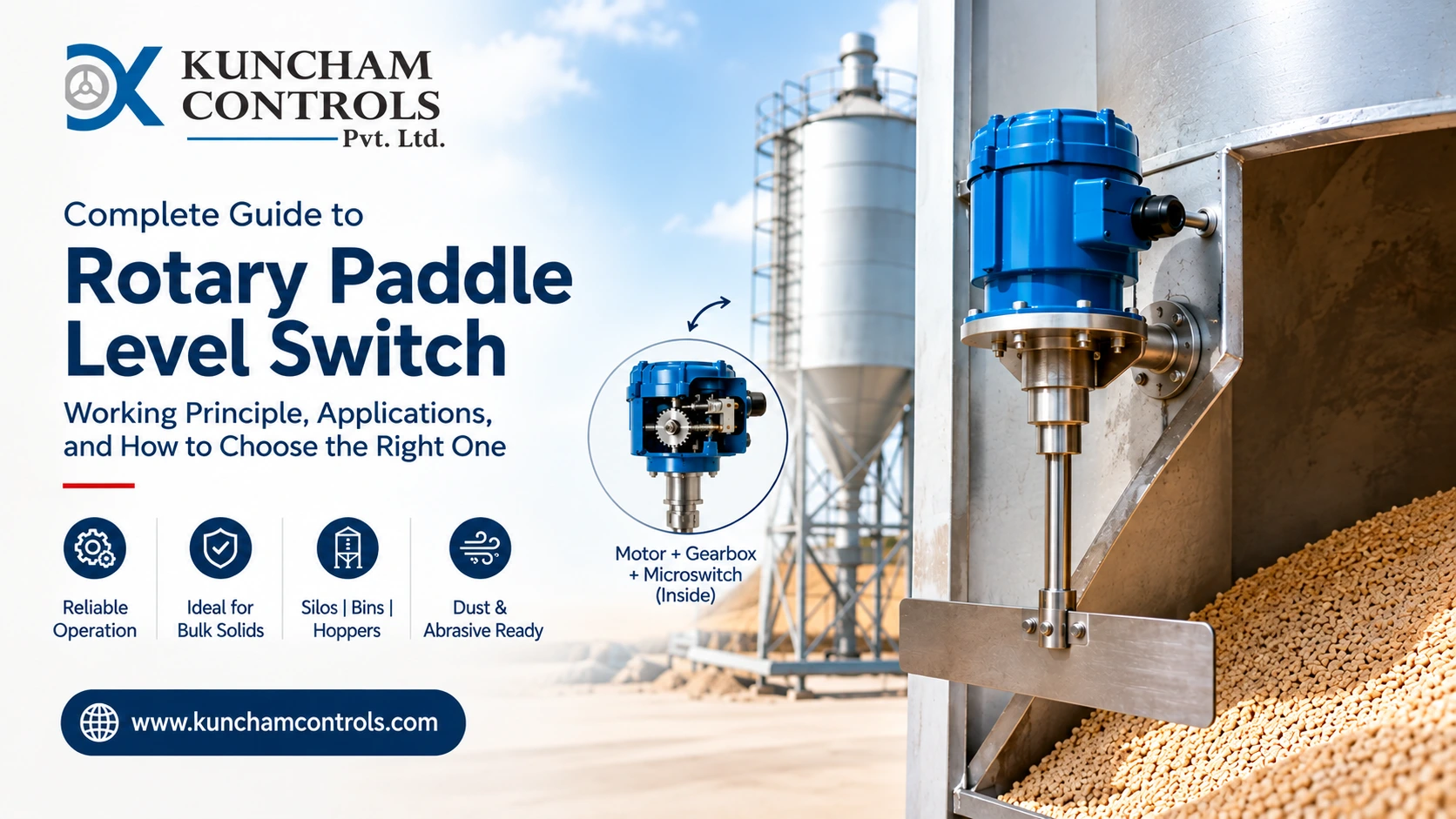
A rotary paddle level switch is one of those devices you rarely think about until it fails — and then it's the only thing you're thinking about. Picture a silo running over because nobody caught the high-level alarm in time, or a hopper running dry mid-batch because a sensor never registered the empty condition. Both scenarios trace back to the same humble component: a small motor turning a paddle inside your vessel, waiting to stop.
If you handle powders, granules, pellets, or any dry bulk material, you've probably specified one of these switches without fully knowing what's happening inside the housing. This guide breaks down the rotary paddle level switch working principle, where these devices fit in a bulk solids monitoring setup, what they can and can't handle, and how to choose the right one for your application. By the end, you'll know exactly how a rotary paddle level switch works and whether it's the right fit for your silo, bin, or hopper.
How Does a Rotary Paddle Level Switch Work?
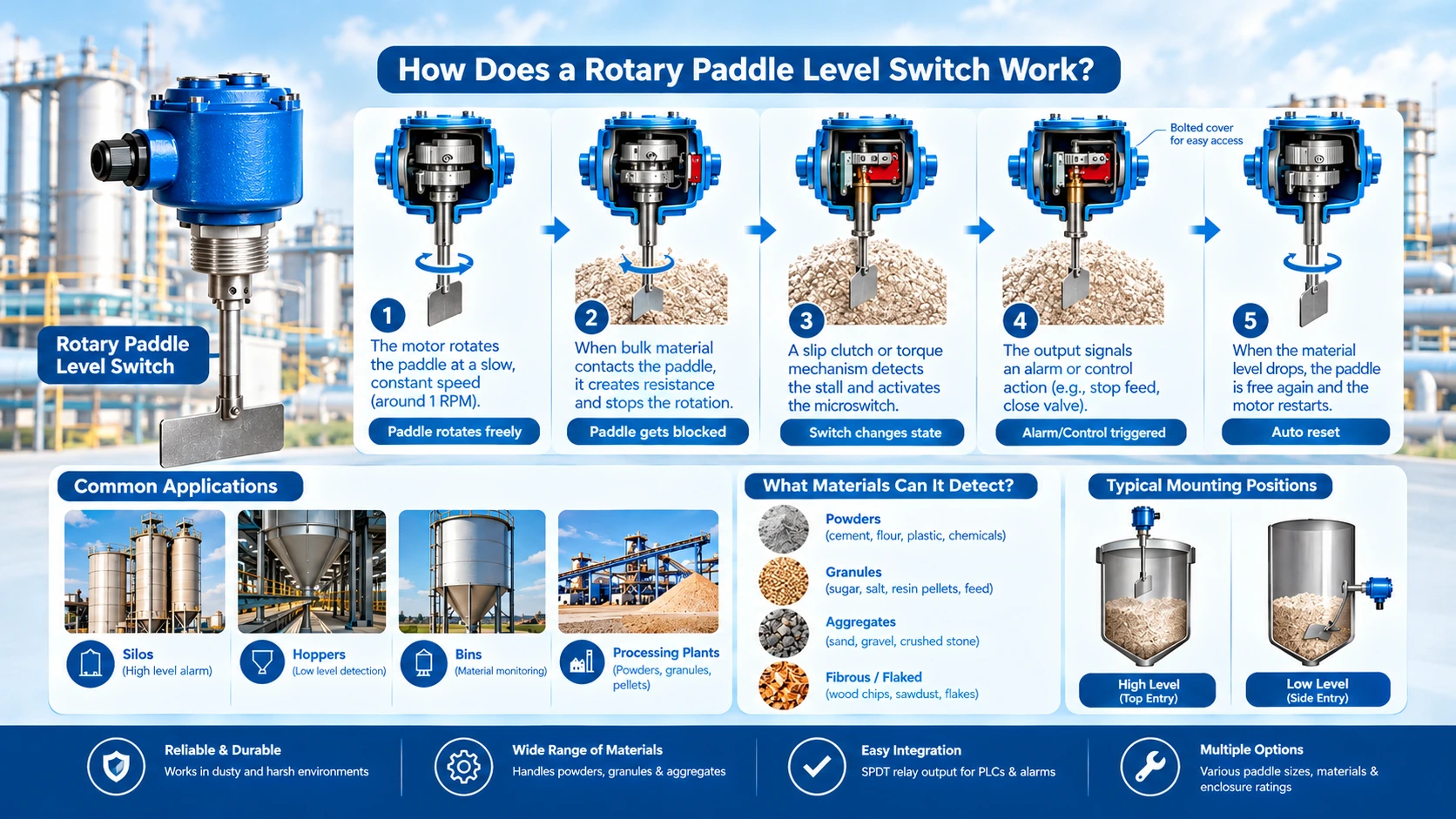
At its core, a rotary paddle level switch uses a small synchronous motor to rotate a paddle at a slow, constant speed — typically around 1 RPM — inside a vessel. As long as the paddle spins freely in open air, the switch stays in its normal state. The moment bulk material rises and makes contact with the paddle, the resistance stops it from turning.
That mechanical stall is the entire trick. A slip clutch or torque-sensing mechanism inside the housing detects the loss of rotation and triggers a microswitch, which changes the output state — sounding an alarm, stopping a conveyor, or closing a feed valve. When the material level drops and the paddle is free again, the motor resumes turning and the switch resets automatically.
This is fundamentally different from continuous level measurement. A rotary paddle switch doesn't tell you how full a vessel is — it tells you whether material has reached one specific point. That's why it's classified as a point level measurement device, not a level transmitter.
The Sequence, Step by Step
The motor drives the paddle shaft through a gearbox, rotating the paddle at low speed.
Bulk material fills the vessel and eventually contacts the rotating paddle.
The paddle's rotation is physically resisted and stalls.
A cam or torque arm inside the housing shifts position due to the stall.
The shift actuates a microswitch, changing the electrical output (usually a relay contact).
The control system reads this as a high-level or low-level alarm, depending on mounting position.
Once material recedes and the paddle clears, the motor restarts rotation and the switch resets.
That reset behavior is worth pausing on. Unlike some point level devices that need manual intervention, a properly functioning rotary paddle switch is self-resetting — it keeps working as material levels cycle up and down, which is exactly what you want in a hopper that fills and empties several times a shift.
Why Bulk Solids Level Detection Needs a Different Approach
Liquid level sensing has it easy, comparatively. Liquids are uniform, they settle to a flat surface, and most sensing technologies — ultrasonic, capacitive, float-based — handle them well. Bulk solids are messier. Powders can bridge or form voids. Granules pile at an angle of repose instead of settling flat. Dust can coat sensor surfaces and throw off readings.
This is where rotary paddle switches earn their keep for powder level detection and granular material monitoring. The mechanical stall principle doesn't care about dielectric constant, dust buildup, or the shape of the material pile the way capacitive or ultrasonic sensors sometimes do. If there's enough material to physically resist the paddle, the switch trips. It's a blunt, reliable method — and in industrial settings, blunt and reliable often beats elegant and finicky.
That said, "reliable" doesn't mean "universal." A rotary paddle switch isn't the right call for every material or every vessel geometry, which we'll get into shortly.
What Materials Can Rotary Paddle Level Switches Detect?
Rotary paddle switches handle a wide range of dry, free-flowing to moderately cohesive bulk solids. Common applications include:
Powders: cement, flour, plastic pellets, chemical powders, pharmaceutical ingredients
Granules: sugar, salt, plastic resin pellets, animal feed
Aggregates: sand, gravel, crushed stone, mineral ore
Fibrous or flaked materials: wood chips, sawdust, flake plastics (with a modified paddle design)
The general rule of thumb: if the material has enough bulk density and mechanical resistance to physically stop a rotating paddle, it's a candidate. Very light, fluffy materials — think fine dust with extremely low bulk density — can sometimes fail to generate enough resistance to trip the switch reliably, so it's worth checking bulk density specs against the manufacturer's minimum torque threshold before you finalize a spec sheet.
Can a Rotary Paddle Level Switch Handle Heavy or Abrasive Materials?
Yes, rotary paddle switches are widely used with heavy and abrasive bulk solids like sand, gravel, ore, and mineral aggregates — but material selection matters here more than anywhere else. Manufacturers offer hardened or abrasion-resistant paddle options (stainless steel with hardened edges, or replaceable paddle tips) specifically for high-wear applications.
A few practical considerations if your material is abrasive or heavy:
Look for units with a heavy-duty gear motor rated for higher torque loads.
Replaceable paddles extend service life significantly in abrasive service — budget for periodic replacement rather than treating the paddle as a lifetime component.
For very dense materials, extension shafts need adequate structural rating to avoid bending under load.
Side-entry mounting in high-impact zones (directly under a fill point) should generally be avoided; even a rugged paddle takes a beating from falling aggregate.
If your process involves extremely heavy impact loading — like material dropping from a significant height directly onto the sensor — a rotary paddle switch positioned away from the direct fill stream will last considerably longer than one sitting in the line of fire.
Rotary Paddle Switch vs. Tuning Fork Switch: What's the Difference?
This comparison comes up constantly during spec reviews, and for good reason — both are point level devices, but they work on completely different principles and suit different materials.
Feature | Rotary Paddle Switch | Tuning Fork Switch |
Operating principle | Mechanical stall of a rotating paddle | Vibration frequency shift when coated by material |
Moving parts | Yes — motor-driven paddle | No — solid-state vibration element |
Best suited for | Bulk solids (powders, granules, aggregates) | Liquids, slurries, and some fine powders |
Maintenance | Motor, gearbox, and paddle wear over time | Minimal — no moving parts to wear out |
Response to buildup/coating | Not typically affected (relies on physical contact) | Can produce false trips from heavy coating |
Typical cost | Moderate | Moderate to slightly higher for liquid-rated versions |
Power consumption | Continuous (motor runs constantly) | Low (intermittent vibration cycle) |
In short: if you're working with dry bulk solids in a silo or hopper, the rotary paddle switch is the more established and typically more cost-effective choice. Tuning fork switches shine in liquid or slurry service, or in applications where you specifically need a device with zero moving parts for reliability in harsh, high-cycle environments.
Where Is the Rotary Paddle Level Switch Typically Mounted?
Mounting position depends entirely on what the switch is meant to detect — high level, low level, or an intermediate point.
High Level Alarm Switch Mounting
For a high level alarm switch application, the switch is mounted near the top of the vessel, positioned to trip before material reaches the fill inlet or overflow point. This gives operators time to stop feed before a silo overflows. Standard practice is to mount it a few inches to a foot below the maximum safe fill line, depending on how fast the vessel fills and how much reaction time the process needs.
Low Level (Empty) Detection
Mounted near the bottom or at a critical minimum-inventory point, these switches trigger when material drops below the paddle — useful for preventing a hopper from running dry mid-process or signaling that a reorder is needed.
Side-Entry vs. Top-Entry Mounting
Top-entry switches use an extension shaft to reach down into the vessel to the desired detection point — common for high-level detection in tall silos.
Side-entry switches mount directly through the vessel wall at the exact detection height — simpler installation, no extension shaft needed, but requires careful placement away from direct fill impact zones and wall build-up areas.
Practical Mounting Tips
Avoid mounting directly beneath the fill inlet or discharge point — falling material can damage the paddle or cause false trips.
Steer clear of areas prone to material bridging or rat-holing near vessel walls, since a bridge can prevent material from ever reaching the paddle even when the vessel is technically full.
For rotary paddle switch for silos applications, a mounting bracket rated for the vessel's internal pressure and temperature range should be confirmed against your process conditions before installation — cutting corners here is a common source of premature failure.
[Link to related post: Flame Arrester Selection Guide for Bulk Storage Silos]
Common Installation and Selection Mistakes to Avoid
A handful of avoidable errors show up again and again in the field:
Undersizing the paddle for the vessel geometry — a paddle too short for the mounting depth may never make contact with settled material.
Ignoring ambient temperature ratings — motor and gearbox components have thermal limits that get overlooked in high-temperature process environments.
Skipping the shaft length calculation for top-entry installs, resulting in a paddle sitting at the wrong detection height.
Not accounting for angle of repose — material piles at an angle, not flat, so a switch mounted at the vessel's geometric center might trip earlier or later than expected depending on paddle position relative to the pile shape.
Choosing a standard paddle for abrasive service and then wondering why it wears out in months instead of years.
[Link to related post: Point Level vs. Continuous Level Measurement — Choosing the Right Technology]
Wiring and Output Considerations
Most rotary paddle switches use a simple SPDT (single-pole double-throw) relay output, which makes integration straightforward with most PLCs and alarm panels. A few things worth checking during specification:
Fail-safe configuration: decide whether you need the switch to fail to an alarm state (fail-safe) or fail to a normal state on power loss — this matters for safety-critical high-level alarms.
Enclosure rating: for dusty environments, an IP66 or equivalent dust-tight enclosure is close to a baseline requirement, not a nice-to-have.
Hazardous area certification: if you're operating in an environment with combustible dust (grain, certain chemical powders), confirm ATEX or IECEx ratings apply to the specific model, not just the product family.
For reference on hazardous area classification standards relevant to combustible dust environments, the IEC's published standards on explosive atmospheres (IEC 60079 series) are a solid starting point for cross-checking certification requirements.
Final Thoughts
A rotary paddle level switch is a straightforward, mechanically robust way to solve a problem that trips up a lot of digital, contactless sensors: reliably detecting bulk solids at a fixed point, regardless of dust, material color, or dielectric properties. Once you understand the rotary paddle level switch working principle — a motor-driven paddle that stalls on contact and resets when clear — the rest is mostly a matter of correct sizing, correct mounting, and matching the paddle material to your process conditions.
If you're setting up bulk solids level detection for a silo, hopper, or bin and you're deciding between a rotary paddle switch and another point-level technology, the deciding factor usually comes down to your material characteristics and your tolerance for moving parts. For dry, dusty, or abrasive solids, the rotary paddle switch remains one of the most field-proven options available — and that reliability is exactly why it's still a standard specification decades after its introduction.
FAQ
How does a rotary paddle level switch work?
A small motor rotates a paddle inside the vessel at low speed. When bulk material contacts the paddle and stops it from turning, a slip clutch mechanism triggers a microswitch that changes the output state, signaling a high or low level condition. The switch resets automatically once the paddle is clear again.
What materials can rotary paddle level switches detect?
They detect a wide range of dry bulk solids, including powders like cement and flour, granules like sugar and plastic pellets, and aggregates like sand and gravel. The material needs sufficient bulk density and mechanical resistance to stall the paddle reliably.
What is the difference between a rotary paddle switch and a tuning fork switch?
A rotary paddle switch uses a motor-driven paddle that physically stalls on contact with material, while a tuning fork switch uses a vibrating element that changes frequency when coated by material or liquid. Paddle switches suit dry bulk solids, while tuning forks are more common in liquid and slurry applications.
Can a rotary paddle level switch handle heavy or abrasive materials?
Yes, with the right configuration — hardened or replaceable paddles, heavy-duty gear motors, and reinforced shafts are all available for abrasive and heavy-density materials like sand, ore, and gravel. Mounting away from direct fill impact zones also extends service life significantly.
Where is the rotary paddle level switch typically mounted on a vessel?
For high-level alarms, it's mounted near the top of the vessel, a set distance below the maximum fill line. For low-level or empty detection, it's mounted near the bottom. Mounting can be top-entry with an extension shaft or side-entry directly through the vessel wall, depending on the detection point and vessel design.