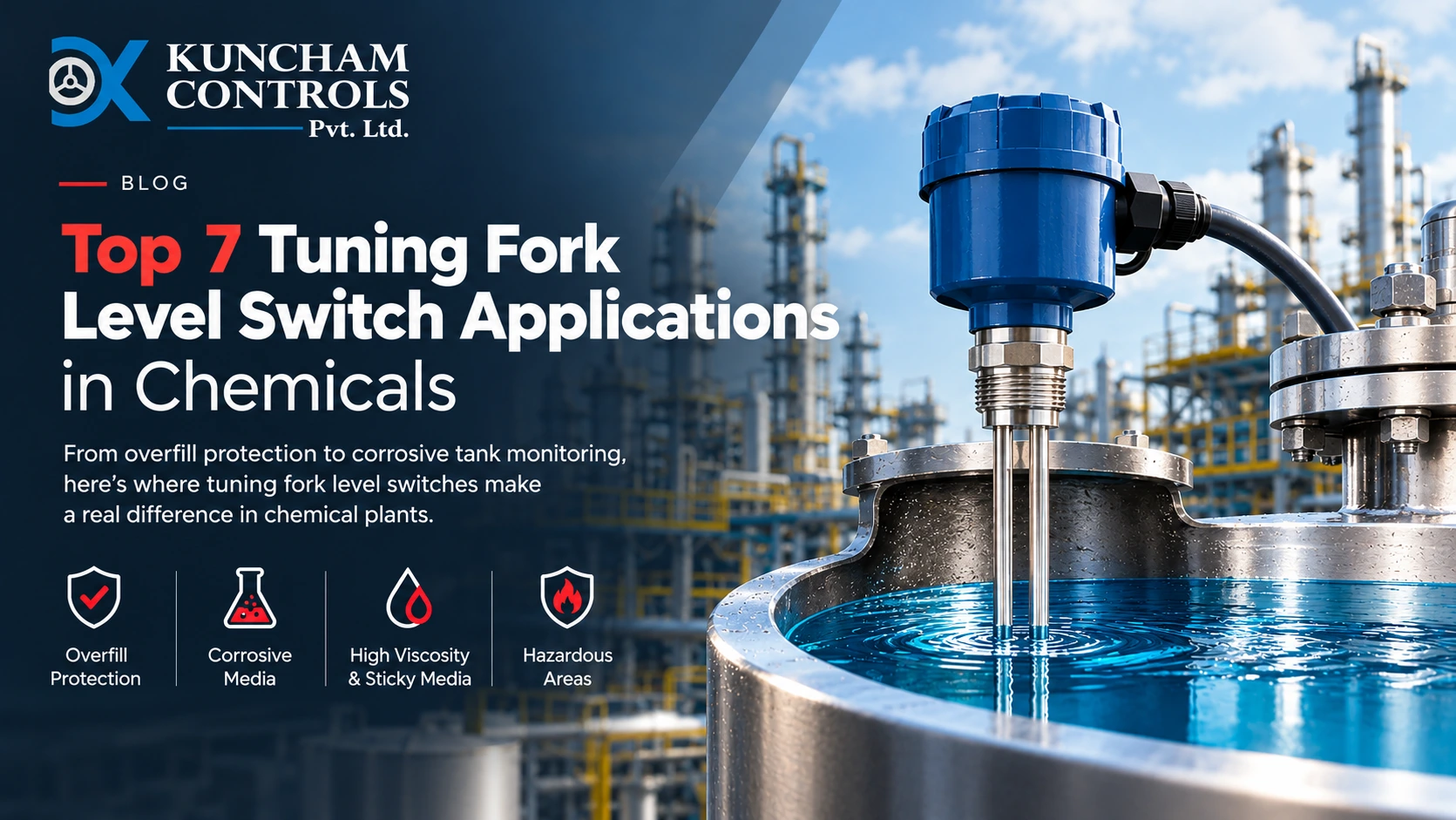
Picture a chemical storage tank three seconds from overflowing, with nobody around to catch it. That’s the exact scenario tuning fork level switch applications are built around, from overfill protection to dry-run safeguards. Ask any process engineer why these vibrating devices show up on nearly every tank, hopper, and reactor skid in a chemical plant, and you’ll get roughly the same answer: they just work, even when the media doesn’t cooperate.
If you’ve ever dealt with a level switch that clogged with resin, drifted because of foam, or failed after six months in a corrosive slurry, you already know why plants keep switching to tuning fork level switches. In this guide, we’ll walk through the top 7 tuning fork level switch applications in the chemical industry, how the technology actually works, and what to check before you specify one for your next project.
How Do Tuning Fork Level Switch Applications Work in Chemical Plants?
A tuning fork level switch works by vibrating two metal prongs at their natural resonant frequency; once the liquid or bulk solid submerges the fork, the vibration slows down and dampens, and the switch's electronics pick up that shift to trigger a high or low level alarm. It sounds almost too simple to be reliable — but that simplicity is exactly why it holds up so well in tough chemical service.
A piezoelectric crystal drives the fork continuously. As long as the prongs are in air or vapor, they oscillate freely at a fixed frequency. The moment the process fluid touches the fork, the added mass and damping effect pull that frequency down, and the switch flips its output state — usually within a second or two. There's no calibration step involved, no zero-point adjustment, and no need to know the fluid's dielectric constant or conductivity beforehand.
That's a real advantage over capacitance probes or conductivity switches, both of which can misread foam, coating, or changes in fluid composition. A tuning fork switch working principle built around mechanical resonance, rather than electrical properties of the fluid, sidesteps most of that trouble entirely.
Why Chemical Plants Keep Choosing Tuning Fork Switches
Chemical processes are rarely gentle on instrumentation. Tanks foam, liquids coat internals, vapors condense, and media ranges from mildly alkaline rinse water to fuming acid. A tuning fork level switch chemical industry deployment has to survive all of that without constant recalibration, which is precisely where this technology earns its keep.
No calibration required — the switch is factory-set and ready to install
Unaffected by foam, turbulence, vapor, or air bubbles in the process fluid
Keeps working even with light coating or buildup on the fork prongs
Rated for wide temperature and pressure ranges, including steam-jacketed vessels
Available in ATEX and IECEx certified versions for hazardous, flammable-vapor areas
Minimal moving parts, which translates into years of maintenance-light service
None of this means tuning fork switches are the answer for every single tank. But for point-level detection — telling you when a liquid has reached, or dropped below, a specific point — they've become close to the default choice across chemical processing.
Top 7 Applications of Tuning Fork Level Switches in the Chemical IndustryHere's where the theory turns into practice. These are the seven places you'll most often find tuning fork level switch applications doing real work on a chemical plant floor, based on how process engineers actually specify and install them.
1. Overfill Protection in Bulk Storage Tanks
This is the application that shows up in nearly every plant safety audit. Tanks holding caustic soda, sulfuric acid, or bulk solvents need an independent high-level alarm that has nothing to do with the primary level transmitter — if that transmitter drifts or fails, the fork switch is the last line of defense before a spill.
Many overfill protection switch installations are SIL-rated and wired into a separate safety instrumented system per IEC 61511, completely isolated from the control-loop instrumentation. During tank truck loading, that independent switch is often the only thing standing between a routine delivery and an environmental incident.
2. High Viscosity and Sticky Media Level Detection
Resins, adhesives, and polymer slurries are notorious for fouling level instruments. A float switch sticks. A capacitance probe reads high forever because of buildup. Tuning fork switches handle high viscosity level detection reasonably well because the fork's vibration amplitude is strong enough to shake off light coating between switch cycles.
For genuinely sticky media — think uncured epoxy or tacky latex compounds — manufacturers offer heated fork versions that keep the prongs warm enough to prevent buildup from setting in the first place. It's a small design tweak that saves a lot of unplanned maintenance.
3. Point Level Detection in Corrosive Chemical Tanks
Hydrochloric acid, sodium hypochlorite, and chlorinated solvents chew through ordinary wetted materials fast. A point level switch for liquids in this kind of service usually needs Hastelloy, tantalum, or a PFA-coated fork to survive more than a few months.
A dosing tank for hydrochloric acid is a textbook case: the switch needs to trigger a low-level alarm before the metering pump runs dry, while the fork itself sits in direct, near-continuous contact with the acid. Get the material selection wrong here and you're replacing switches every quarter.
4. Interface Detection Between Two Liquids
Oil-water separators, solvent recovery units, and decanters all rely on knowing exactly where one liquid layer ends and another begins. Tuning fork switches, tuned to the density difference between the two phases, can flag that interface reliably enough to trigger automatic draw-off valves.
It's not the most common use case on this list, but where it applies — particularly in solvent recovery — it removes a job that used to depend entirely on an operator eyeballing a sight glass.
5. Dry-Run Protection for Chemical Transfer Pumps
Running a centrifugal pump dry for even thirty seconds can wreck a mechanical seal, and with corrosive or flammable chemicals, a seal failure isn't just an expensive repair — it's a safety event. A low-level tuning fork switch mounted near the tank outlet cuts the pump before it ever runs dry.
This is one of the simplest, cheapest safeguards a plant can add, and it pays for itself the first time it prevents a seal replacement on a chemical transfer pump.
6. Powder, Granule, and Catalyst Level Detection in Hoppers
Not every application here involves liquid. Vibrating fork and rod variants are also used in hoppers and silos feeding catalyst pellets, powdered additives, or resin beads into a reactor. Bridging and rat-holing — where bulk solids clump and give a false empty reading — are common headaches that fork-style switches handle better than most alternatives.
For catalyst-fed reactors especially, knowing exactly when a hopper is running low prevents an unplanned reaction upset, which is a far bigger problem than a late refill.
7. Batch Reactor High and Low Level Alarms
Batch reactors live and die by precise charging sequences. A tuning fork switch set as a high-level alarm stops an addition before overflow; the same technology set as a low-level alarm confirms the reactor has enough volume before an agitator or heating jacket kicks in.
Because these switches respond in roughly a second and don't drift with the reaction's changing viscosity or foam profile as the batch progresses, they're a natural fit for the fast, repeatable charging cycles batch chemistry demands.
Flame Arresters for Chemical Storage Tanks
Choosing the Right Tuning Fork Switch for Your Process
Specifying a switch isn't just about picking a brand off a catalog page. Wetted material, process temperature, pressure rating, and hazardous area classification all narrow the field fast. Here's a quick reference for material selection based on the chemical service involved:
Wetted Material | Typical Chemical Service | Why It's Specified |
|---|---|---|
316L Stainless Steel | Mild acids, alkalis, general process water, solvents | Cost-effective baseline with solid corrosion resistance |
Hastelloy C-276 | Concentrated sulfuric or hydrochloric acid, chlorides | Withstands aggressive, high-chloride environments |
PFA / ETFE Coated | Hydrofluoric acid, strong oxidizers, ultra-pure chemicals | Near-universal chemical resistance, non-stick surface |
Tantalum | Extremely corrosive, high-temperature acid duty | Handles conditions where even Hastelloy struggles |
Beyond material, check the switch's response time against your process speed, confirm the certification matches your area classification (ATEX, IECEx, or PESO for installations in India), and make sure the output — relay, NAMUR, or transistor — matches your control system. According to the ISA, matching instrumentation certification to the actual area classification remains one of the most common gaps found during safety audits.
Installation and Maintenance Best PracticesMounting orientation matters more than most people expect. A fork installed too close to a fill stream or agitator blade can trigger false alarms from turbulence alone, so manufacturers typically recommend keeping at least a few inches of clearance from inlets, baffles, and mixer paths.
Mount the fork horizontally for point-level detection, vertically from the top for high/low alarms
Keep a minimum clearance from tank walls, inlets, and agitator blades to avoid turbulence-triggered trips
Verify the fork orientation matches the manufacturer's diagram — some designs are direction-sensitive
Inspect wetted materials annually in aggressive chemical service, even without a fault indication
Test the switch output during scheduled shutdowns rather than waiting for an alarm to prove it works
Most tuning fork switches need very little hands-on maintenance — that's the whole point of the technology. A visual inspection once or twice a year, plus a functional test during planned shutdowns, is usually enough for switches in moderate chemical service. Highly corrosive or abrasive applications warrant a closer look, maybe quarterly, simply to catch early signs of wetted-part erosion before it becomes a failure.
Final Takeaway: Why Tuning Fork Level Switch Applications Keep GrowingAcross storage tanks, dosing skids, hoppers, and batch reactors, tuning fork level switch applications keep showing up for the same reason: they hold up where other level technologies struggle, and they do it without demanding constant attention. If your process involves foam, coating, corrosive media, or anything that makes calibration a headache, a tuning fork switch is worth putting at the top of your shortlist.
Need help specifying the right switch, material, or certification for your next chemical processing project? Reach out to a process instrumentation specialist before you finalize your P&ID — getting the material selection right the first time is far cheaper than replacing a failed switch six months into operation.
Frequently Asked QuestionsHow does a tuning fork level switch work?
A tuning fork level switch vibrates two metal prongs at a fixed resonant frequency using a piezoelectric crystal. When liquid or bulk solid covers the fork, the vibration frequency drops and dampens, and the switch's electronics detect that change to trigger a high or low level output.
Why are tuning fork level switches popular in the chemical industry?
They require no calibration, resist false triggering from foam and turbulence, and keep working even with minor coating on the prongs. Combined with ATEX and IECEx certified versions for hazardous areas, that reliability makes them a practical default for point-level detection in chemical plants.
Can tuning fork switches be used for both high and low level alarms?
Yes. The same fork technology works for both — mounted near the top of a vessel it functions as a high-level or overfill alarm, and mounted lower it serves as a low-level or dry-run alarm. Many plants use two separate units on the same tank for redundant protection.
Are tuning fork level switches suitable for hazardous or corrosive chemicals?
Yes, when the wetted parts are matched to the chemical. Standard 316L stainless steel handles mild acids and alkalis, while Hastelloy, tantalum, or PFA-coated forks are used for concentrated acids and highly corrosive media. ATEX and IECEx certified models are also available for flammable or explosive atmospheres.
How often do tuning fork level switches need maintenance?
In moderate chemical service, an annual visual inspection plus a functional test during scheduled shutdowns is usually sufficient. In highly corrosive or abrasive applications, a quarterly check of the wetted parts is a safer interval to catch early erosion before it causes a failure.