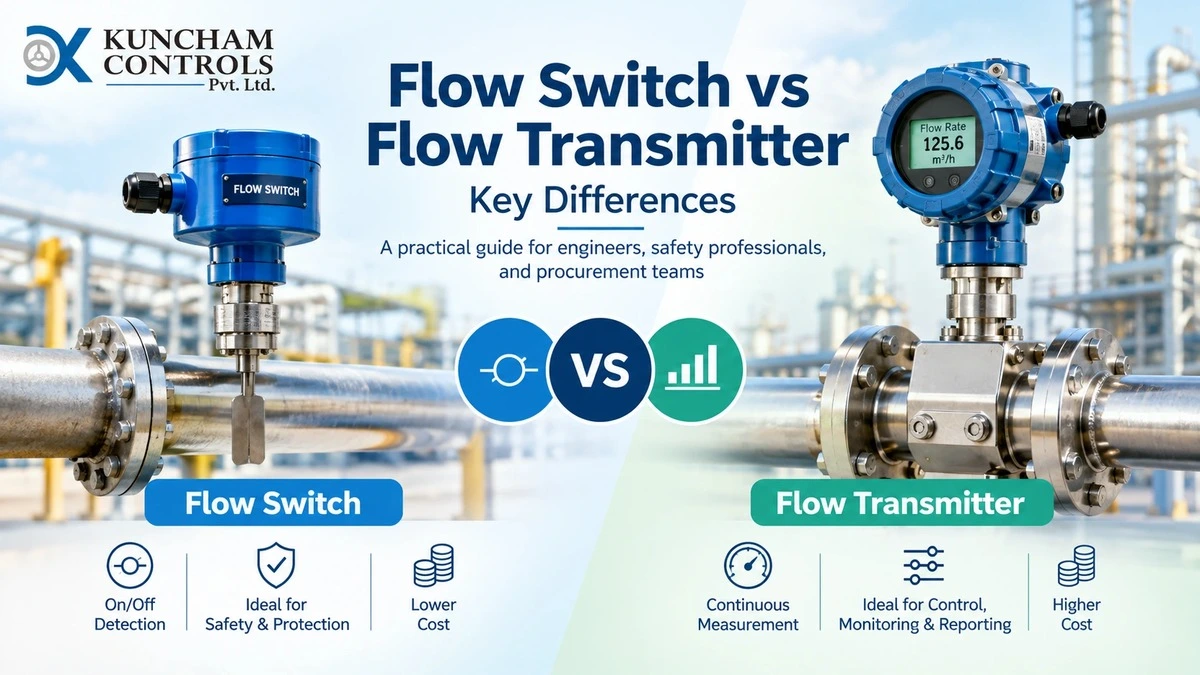
Picture a pump running dry because nobody caught the loss of flow in time, or a control loop drifting because the wrong instrument got specified in the first place. Both scenarios trace back to a question engineers get wrong more often than you'd expect: flow switch vs flow transmitter, and which one actually belongs in your line. A flow switch tells you flow either exists or it doesn't. A flow transmitter tells you exactly how much is moving, every second, in numbers you can log, trend, and act on. That's the whole distinction in one sentence — but the decision behind it touches your budget, your control philosophy, and sometimes your plant's safety case.
This guide breaks down flow switch application versus flow transmitter application in plain terms, so you can specify the right device the first time instead of finding out the hard way during commissioning.
What Is a Flow Switch?
A flow switch is a simple on-off device that triggers an electrical contact once flow crosses a pre-set threshold — either too low or too high. It doesn't measure quantity; it reports a state. Think of it as a tripwire for your piping system rather than a speedometer.
In a control panel, a flow switch usually shows up as a single digital input: flow okay, or flow lost. That binary simplicity is exactly why it's still standard equipment in dozens of plants across India's process industries, even with far more sophisticated instrumentation available.
Flow Switch Working Principle
Most flow switches on the market rely on one of three mechanisms:
Paddle or vane type: a metal paddle deflects against spring tension as flow pushes past it; once flow drops below the set point, the paddle springs back and trips a microswitch.
Thermal dispersion type: a heated sensor element loses heat faster when flow is present; the switch trips once the cooling rate — and therefore the flow — drops below a set threshold.
Differential pressure type: flow through a fixed restriction creates a pressure drop; the switch actuates when that drop moves outside its set range.
None of these designs tell you the flow rate in liters per minute or GPM. They give you exactly one bit of information — flow is fine, or it isn't — and for a huge number of applications, that's genuinely all you need.
What Is a Flow Transmitter?
A flow transmitter continuously measures the actual flow rate — and often totalized volume — and converts it into a standard output, typically 4-20 mA or HART, that feeds your PLC, DCS, or SCADA system. Where a switch answers "yes or no," a transmitter answers "how much, right now."
Because the output is a live, scalable signal rather than a contact closure, a flow transmitter becomes part of your control strategy, not just your alarm strategy. It can drive a PID loop, feed a batching sequence, or generate the data your plant needs for regulatory or custody-transfer reporting.
Flow Transmitter Working Principle
Depending on the fluid, line size, and accuracy requirement, a flow transmitter might use:
Differential pressure (orifice/venturi): infers flow rate from the pressure drop across a known restriction — an old, well-proven approach for liquids, gases, and steam.
Electromagnetic (magmeter): measures the voltage induced by a conductive fluid moving through a magnetic field — a strong choice for water, slurries, and wastewater.
Vortex: counts the frequency of vortices shed behind a bluff body, which scales with velocity — common on steam and gas lines.
Ultrasonic: uses transit-time or Doppler shift of sound waves to calculate velocity, often clamp-on and non-intrusive.
Coriolis: measures mass flow directly through the twist induced in a vibrating tube — the go-to when you need high accuracy and density data together.
Each technology has its own strengths and installation quirks — that's a topic for its own brief — but the shared thread across all of them is continuous flow measurement rather than a single trip point.
Flow Switch vs Flow Transmitter: Core Differences
Here's the comparison side by side. This is the table worth bookmarking when you're writing a spec sheet.
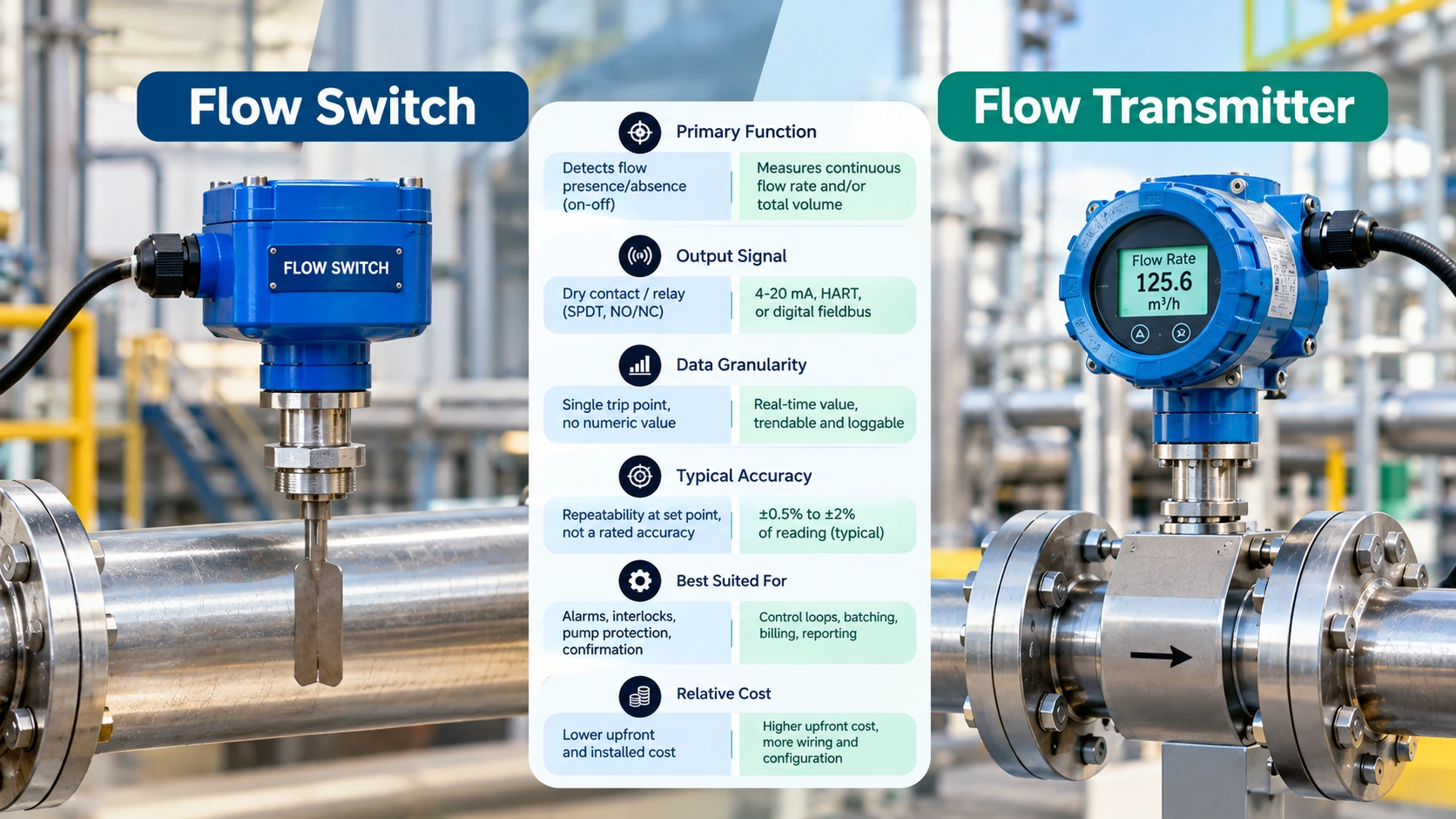
Parameter | Flow Switch | Flow Transmitter |
|---|---|---|
Primary function | Detects flow presence/absence (on-off) | Measures continuous flow rate and/or total volume |
Output signal | Dry contact / relay (SPDT, NO/NC) | Analog 4-20 mA, HART, or digital fieldbus |
Data granularity | Single trip point, no numeric value | Real-time value, trendable and loggable |
Typical accuracy | Repeatability at set point, not a rated accuracy | Rated accuracy, often ±0.5% to ±2% of reading |
Best suited for | Alarms, interlocks, pump protection, confirmation | Control loops, billing, batching, reporting |
Relative cost | Lower upfront and installed cost | Higher upfront cost, more wiring and configuration |
Panel integration | Simple relay/contact wired to PLC digital input | Loop-powered, wired to analog input or fieldbus |
The table makes the split obvious: a switch is a decision-maker for a single condition, and a transmitter is a data source for everything downstream of it. Neither is "better" in the abstract — they solve different problems.
Flow Switch Applications: When On-Off Detection Is Enough
On-off flow detection earns its place whenever the only thing that matters is whether flow exists at all. Common flow switch applications include:
Pump dry-run protection — shutting down a centrifugal pump before it runs dry and damages the seals or bearings
Cooling water verification — confirming coolant is flowing before allowing a furnace, compressor, or welding process to start
Low-flow alarms on heat exchangers, where loss of flow risks fouling or thermal damage
Simple interlocks that block a process step — like energizing a heater — until flow is confirmed present
Lubrication line monitoring on rotating equipment, where a missed lube cycle can mean an expensive failure
Notice the pattern: these are almost all protective, binary decisions. Nobody needs to know the exact flow rate of the cooling water going into a heat exchanger jacket — they need to know it’s flowing before something expensive gets damaged. For heat exchangers, many plants also pair the flow alarm with a temperature transmitter, so a gradual rise in outlet temperature is caught early, even before flow drops enough to trip the switch.
Flow Transmitter Applications: When You Need Continuous Data
Flow transmitter application shifts the conversation from protection to precision. You'll want continuous flow measurement whenever the number itself drives a decision, not just its presence or absence:
Custody transfer and billing, where accuracy directly affects money changing hands
Batching and dosing in chemical, food, or pharma processes, where the totalized volume must be tightly controlled
PID control loops that need a live process variable to modulate a control valve or VFD
Regulatory or emissions reporting, where flow data must be logged, time-stamped, and auditable
Chemical injection and dosing skids, where under- or over-dosing has real safety or product-quality consequences
If your process needs to answer "how much" rather than just "is it flowing," you're already in flow transmitter territory — a switch simply can't give you that number.
Cost Comparison: Is a Flow Transmitter More Expensive?
Generally, yes — a flow transmitter costs more than a flow switch, often by a significant margin, and the gap widens further once you factor in installation. A basic paddle-type flow switch is a mechanical device with a single output contact; there's not much to engineer or calibrate. A flow transmitter, on the other hand, is a precision measurement instrument with its own signal conditioning, calibration certificate, and — depending on the technology — a fairly involved installation.
That said, cost comparisons only make sense against the job the device is doing. Specifying a Coriolis transmitter where a paddle switch would do is over-engineering and over-spending. Specifying a switch where you actually need billing-grade accuracy is a compliance problem waiting to happen. The right question isn't "which is cheaper" — it's "which one actually answers the question my process is asking."
Installation Considerations for Both Devices
Installation requirements differ meaningfully between the two, and getting this wrong is one of the most common sources of nuisance trips and inaccurate readings.
Flow Switch Installation
Straight pipe run requirements are typically modest — check the manufacturer's datasheet, but paddle types are relatively tolerant
Orientation matters for paddle types; horizontal lines are generally preferred to avoid gravity affecting the paddle's return
Wiring is simple: a dry contact or relay output wired directly to a PLC digital input or an alarm circuit
Set points need periodic verification, especially on paddle types where spring tension can drift over years of service
Flow Transmitter Installation
Upstream and downstream straight pipe runs are usually stricter — differential pressure and vortex meters in particular are sensitive to flow disturbances from elbows and valves
Grounding and shielding matter more, since you're protecting an analog signal from electrical noise
Loop power and wiring need proper 4-20 mA or HART configuration, often through a marshalling cabinet
Calibration and configuration — range, damping, output scaling — should be verified against process conditions, not just factory defaults
Do both devices require the same installation approach? Not really. A flow switch is close to plug-and-play; a flow transmitter usually needs more attention to piping geometry, grounding, and loop configuration to hit its rated accuracy.
Making the Right Choice for Your Process
Before you specify either device, walk through these questions:
Do you need a number, or a yes/no? If the answer is a number — for control, billing, or reporting — you need a transmitter.
Is this a safety or protective function? Both can serve interlocks, but a switch is often simpler to certify and maintain for straightforward protective duty.
What's your budget and maintenance capability? A flow switch is cheaper and lower-maintenance; a transmitter demands more calibration discipline.
Does your control system need a live process variable? If a PLC or DCS loop needs continuous input, only a transmitter delivers that.
What accuracy does the application genuinely require? Don't over-spec instrumentation accuracy your process can't use anyway.
In a lot of real plants, the honest answer is "both" — a flow switch for the fast, protective trip, and a flow transmitter for the process data and control loop, wired into the same line for different jobs.
Final Takeaway
The flow switch vs flow transmitter decision isn't really about which device is more advanced — it's about matching the instrument to the question your process is actually asking. If you just need to know flow is present, a switch is faster to install, cheaper to maintain, and does the job without unnecessary complexity. If you need to know exactly how much is flowing, at any given moment, a transmitter is the only device built for that. Get this decision right at the specification stage, and you'll avoid nuisance trips, over-engineered budgets, and control loops that never quite behave.
Need help specifying flow instrumentation for a specific line or reviewing an existing P&ID for gaps in flow monitoring instrumentation? For deeper technical references on flow measurement standards, ISA's instrumentation guidelines (isa.org) are worth bookmarking.
Frequently Asked Questions
What is the basic difference between a flow switch and a flow transmitter?
A flow switch detects whether flow is present or absent and triggers a contact at a set threshold — it's an on-off device. A flow transmitter continuously measures the actual flow rate and sends that value as an analog or digital signal for monitoring and control.
When should I use a flow switch instead of a flow transmitter?
Use a flow switch when you only need a protective or confirmatory signal — for example, pump dry-run protection, cooling water verification, or a simple interlock. If you don't need an actual flow value, a switch is simpler, cheaper, and easier to maintain than a transmitter.
Is a flow transmitter more expensive than a flow switch?
Yes, in most cases. A flow transmitter is a precision measurement instrument with calibration and signal-conditioning requirements, which pushes both the equipment cost and installation cost above that of a basic flow switch. The gap depends heavily on the transmitter technology chosen.
Can a flow switch be used for safety interlocks?
Yes — flow switches are commonly used in safety interlocks, such as blocking heater energization until cooling flow is confirmed. For SIL-rated safety instrumented functions, make sure the specific switch is certified for that application, since not every flow switch carries a safety rating.
Do both devices require the same installation approach?
No. Flow switches generally have more relaxed straight-run and orientation requirements and use simple contact wiring. Flow transmitters usually need stricter upstream/downstream piping, careful grounding, and proper loop configuration to hit their rated accuracy.