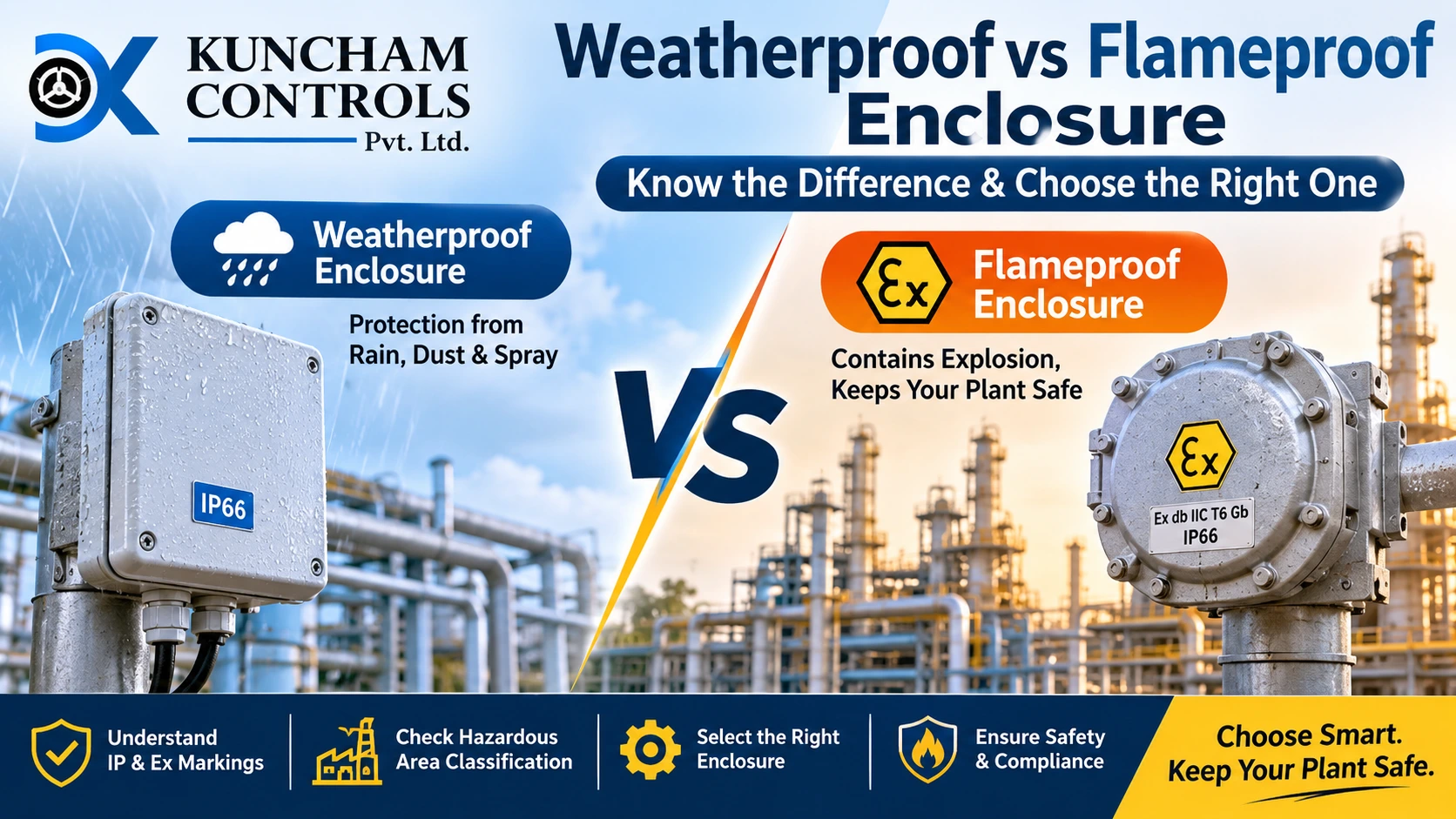
A weatherproof enclosure keeps rain, dust and spray out. A flameproof enclosure keeps an internal explosion in. That's the heart of the weatherproof vs flameproof enclosure question, and getting it backwards is one of the costlier mistakes you can make on a plant.
Here's the uncomfortable part. A box can be beautifully sealed against a hose-down and still be a poor choice beside a solvent pump. The opposite error hurts too: bolting heavy flameproof housings onto every instrument on site because nobody pulled the area classification drawing.
This guide shows what each enclosure actually protects against, how IP and Ex markings differ, and how to choose the right housing for each instrument location.
Two Different Jobs: What Each Enclosure Is Built to Do
The weatherproof enclosure: protection from the environment
"Weatherproof" isn't a certification. It's shorthand, and on most data sheets it means IP65 or IP66 (or NEMA 4/4X in North American catalogues). The housing protects electronics from rain, washdown, dust and, depending on material, corrosion.
What it doesn't do is stop ignition. Flammable vapour can still creep in slowly through cable entries and breathing cycles. Once it's inside a sealed box, a relay contact or a loose terminal is all it takes.
The flameproof enclosure: containing the worst case
A flameproof enclosure (Ex d) starts from a blunt assumption: explosive gas will get inside. So the design makes sure the explosion stays inside too. The same flame-quenching principle is used in an industrial flame arrester fitted on tank vents and pipelines.”
The walls are thick castings, usually aluminium alloy, stainless steel or cast iron. The joints are machined flame paths, precise gaps between flanges or threads that cool escaping gas below its ignition temperature. Each design is tested against pressures higher than the explosion itself generates, under the IEC 60079-1 standard.
You'll also hear "explosion proof instrument enclosure." That's the North American term. It's closely related but follows different rules (Class/Division, UL 1203), so don't treat the two names as interchangeable on an Indian or European specification.
IP Rating vs Ex Rating: Two Labels, Two Questions
These markings answer completely different questions. Confusing them is where most selection errors start.
What a weatherproof enclosure rating tells you
An IP code, defined in IEC 60529, has two digits. The first (0 to 6) describes protection against solids and dust. The second (0 to 9) covers water.
IP65: dust-tight and protected against low-pressure water jets.
IP66: dust-tight and protected against powerful jets, which is the usual outdoor minimum.
IP67: dust-tight and survives temporary immersion.
Notice what's missing. Nothing in an IP code says anything about gas, sparks or explosions.
How to read an Ex marking
The Ex marking is the one that matters in a hazardous area. Take a typical label: Ex db IIC T6 Gb IP66.
Ex: certified for explosive atmospheres.
db: flameproof protection, the Ex d family.
IIC: gas group. IIC (hydrogen, acetylene) is the most demanding; IIB covers ethylene, IIA covers propane.
T6: maximum surface temperature of 85°C.
Gb: equipment protection level suited to Zone 1.
IP66: yes, the IP rating sits on the same plate.
That last line is worth remembering. A good flameproof enclosure carries both. Rain getting into a cast housing corrodes the flame paths and wrecks the electronics, so "explosion-safe" doesn't excuse a weak IP rating.
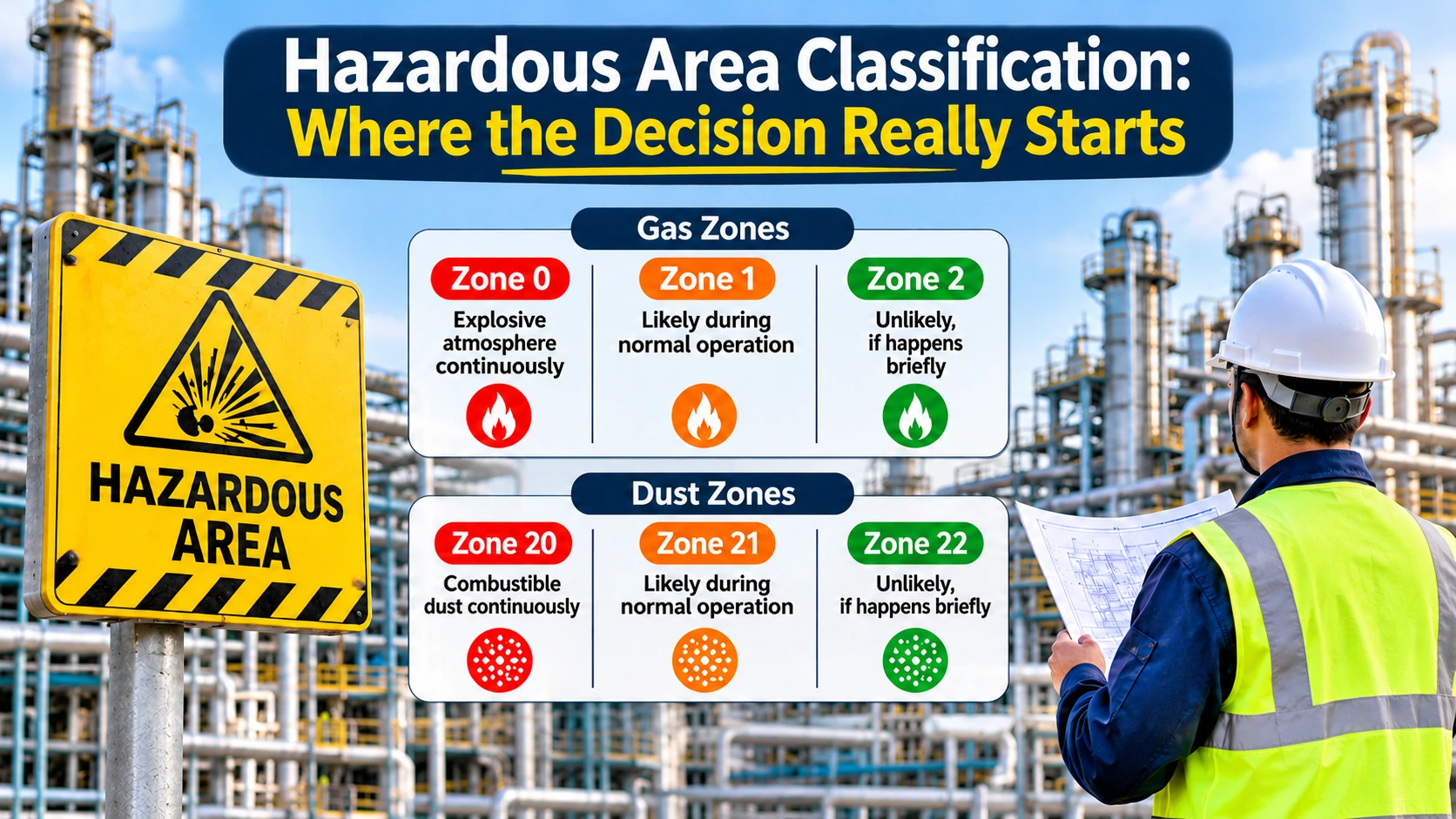
Hazardous Area Classification: Where the Decision Really Starts
Don't open a catalogue yet. Open the hazardous area classification drawing.
Gas areas are split into three zones. Zone 0 has an explosive atmosphere continuously or for long periods. Zone 1 is where one is likely during normal operation. Zone 2 is where it's unlikely and, if it happens, brief. Dust areas use Zones 20, 21 and 22 in the same pattern. The method is laid out in IEC 60079-10-1, and it's a job for process safety engineers, not purchasing.
A quick picture. A transmitter next to a solvent transfer pump, close to a seal that can leak in normal running, probably sits in Zone 1. A junction box in a fenced utility yard, away from any release source, is non-hazardous. Same site, same weather, very different enclosures. Dust areas use Zones 20, 21 and 22 in the same pattern, which matters for silo instruments such as tuning fork level switches.
Does good ventilation remove the need?
It can change the classification, but you can't assume it. Adequate ventilation may reduce the extent of a zone or downgrade it from Zone 1 to Zone 2, and that reasoning has to be written into the classification study. If it isn't documented, treat the area as classified.
Weatherproof vs Flameproof Enclosure: A Side-by-Side Comparison
Here's the practical difference at a glance.
Feature | Weatherproof enclosure | Flameproof enclosure |
|---|---|---|
Main job | Keeps water, dust and dirt out | Contains an internal explosion and stops flame escaping |
Governing standard | IEC 60529 (IP code) | IEC 60079-1, plus the IP code |
Marking | IP65, IP66, IP67 and similar | Ex db / Ex d, gas group, T class, EPL, IP |
Hazardous area use | Not on its own | Yes, within its certified zone, group and temperature class |
Typical build | Polycarbonate, GRP, painted or stainless steel | Thick cast aluminium, stainless or cast iron with machined flame paths |
Weight and cost | Light and economical | Heavier and noticeably more expensive |
Care needed | Check gaskets and corrosion | Protect flame paths; use certified glands and the specified bolts |
Instrumentation Enclosure Selection: A Six-Step Checklist
Use this order every time. It keeps the paperwork honest.
Pull the classification drawing. Note the zone, gas group and temperature class for the exact tag location.
Check the process. The enclosure's T class must stay below the auto-ignition temperature of the gases present.
Match the gas group. An IIC enclosure can serve IIA and IIB areas. It doesn't work the other way round.
Pick the protection concept. Flameproof isn't the only road. Low-power transmitters are often better served by intrinsic safety (Ex i), and terminal boxes by increased safety (Ex e).
Set the IP rating for the weather. IP66 is the sensible outdoor floor. On a coastal or chemical site, consider 316 stainless or GRP for corrosion.
Verify certificates and accessories. Look for valid ATEX or IECEx documentation, plus any statutory approval your location needs, such as PESO in India. Cable glands and blanking plugs must carry matching Ex certification.
A tank-farm example
Picture a level transmitter on top of a solvent storage tank. The roof area is Zone 1, the gas group is IIB and the vapour's ignition temperature is well above 200°C. An Ex db IIB T4 Gb IP66 housing fits. The marshalling cabinet 80 metres away in a safe-area control room only needs a standard IP54 panel. Paying for flameproof there buys you nothing.
Weatherproof vs Flameproof Enclosure: Where Plants Go Wrong
Treating IP66 as "safe enough." It's a weather rating. It says nothing about ignition.
Fitting uncertified cable glands. One ordinary gland on a certified enclosure voids the whole assembly.
Leaving unused entries plugged with standard plugs. Use certified blanking elements, always.
Painting over flame paths. Thick paint, grease the wrong type or a scratched flange face can undermine the gap the design depends on.
Using the wrong fasteners. Flameproof covers need the specified bolt grade and every bolt in place.
Opening live enclosures in the area. Isolate first, and follow your gas-free work permit.
Specifying Ex d everywhere to be "safe." You'll pay for weight, extra maintenance and slower installation where the area isn't classified.
One habit pays for itself: keep photographs of each enclosure's nameplate in your asset register. When an auditor asks about the rating of tag 14, you'll have the answer in seconds.
Choose by Hazard First, Weather Second
The weatherproof vs flameproof enclosure decision isn't a contest. They solve different problems. Weatherproofing protects the instrument from the site. Flameproofing protects the site from the instrument.
Start with the area classification, read the Ex marking before the IP code, and make sure the glands and plugs match. Then pick the cheapest housing that satisfies both. For further reading, the IEC 60079 series on the IEC website is the authority to check against.
Not sure what your plant areas need? Send us your classification drawing and instrument list, and we'll help you shortlist the right enclosures. [Link to related post: flameproof enclosure certification explained]
Frequently Asked Questions
What is the difference between a weatherproof and a flameproof enclosure?
A weatherproof enclosure protects equipment from rain, dust and water, and is described by an IP rating. A flameproof enclosure is built to withstand an internal explosion and stop flames escaping, and is certified with an Ex marking. Only the flameproof type is designed for use in classified hazardous areas.
Do I need a flameproof enclosure if my area already has good ventilation?
Not automatically. Good ventilation can reduce the size or grade of a hazardous zone, and sometimes that opens up other protection methods. But the reduction must be documented in the area classification. Without that, assume the original zone applies.
What does an IP rating tell me about an enclosure?
An IP rating shows how well an enclosure resists solids and water. The first digit covers dust (0 to 6) and the second covers moisture (0 to 9). IP66, for example, means dust-tight and protected against powerful water jets. It says nothing about explosion protection.
Can a flameproof enclosure be used in a non-hazardous outdoor area?
Yes. A flameproof enclosure with a suitable IP rating, such as IP66, works fine outdoors in a safe area. It's usually heavier and more expensive than needed, so it only makes sense when you want one standard across the plant or the location might be reclassified later.
How do I determine which enclosure rating my plant area requires?
Start with the hazardous area classification drawing, which gives the zone, gas group and temperature class for each location. Then choose an Ex-marked enclosure that meets or exceeds those values. Add an IP rating that suits the weather, and confirm the certificates with your safety engineer.