Good instrumentation for pharmaceutical plants comes down to three things: hygienic design that can't harbour product or microbes, materials that shrug off cleaning and sterilization, and paperwork that proves every instrument does what you claim. Specify pressure, level and flow devices against those three and most audit surprises disappear.
Easier said than done. A standard industrial transmitter can measure perfectly and still fail an inspection because of a threaded connection, a missing material certificate or a calibration record with gaps. Nobody wants to find that out during qualification.
Use this checklist to specify, compare and document pressure, level and flow instruments before the purchase order goes out.
Why Instrumentation for Pharmaceutical Plants Plays by Different Rules
In a general industrial plant, a drifting instrument is a quality headache. In pharma, it can put a whole batch at risk, and sometimes your regulatory standing along with it. That changes what "good enough" means.
Cleanable by design
Threads, crevices and dead legs trap product, and trapped product feeds microbes. Hygienic design means smooth, drainable, gap-free surfaces.
These instruments also live through repeated cleaning-in-place (CIP) with hot caustic and acid, and steam-in-place (SIP) at around 121°C or higher. A device rated only for the process temperature won't last.
Built for GMP scrutiny
Good manufacturing practice expects equipment to be suitable, calibrated and documented. The usual reference points are 21 CFR Parts 210 and 211, EU GMP Annex 15 on qualification, ISPE GAMP 5 for anything with software, and ASME BPE for bioprocessing equipment design.
Know your GMP-critical instruments
Not every gauge deserves the same attention. A GMP-critical instrument is one whose reading affects product quality or patient safety, such as sterilizer pressure, WFI flow or bioreactor level. Critical devices get full qualification and tighter calibration. A utility water gauge usually doesn't.
A simple test: if a wrong reading could change a batch release decision, treat the instrument as critical.
The Universal Checklist: Eight Specs Every Instrument Must Meet
Whatever you're measuring, run each instrument through these points first.
1. Wetted material. 316L stainless steel is the baseline. Move to Hastelloy C-22 or similar for chloride-heavy or aggressive media.
2. Surface finish. Product-contact surfaces are commonly specified at Ra 0.8 µm or better, often electropolished. Match your URS.
3. Process connection. Tri-clamp with a flush, crevice-free fit. Avoid threaded connections in product contact.
4. Seals and elastomers. EPDM, PTFE or silicone with USP Class VI or FDA compliance statements.
5. Temperature tolerance. The device and its seals must handle SIP temperature and thermal shock, not just process temperature.
6. Drainability. Mount so the line drains, and keep dead legs short, following ASME BPE guidance.
7. Housing and ingress. Stainless housings and IP66/IP67 or better for washdown areas.
8. Electronics and data. HART or fieldbus diagnostics are useful. If settings or records are stored electronically, check audit trail and 21 CFR Part 11 expectations with QA.
Temperature follows the same hygiene rules, so see [Link to related post: RTD vs thermocouple] when you're specifying sensors for sterilizers and jacketed vessels.
Pressure Monitoring: Choosing a Hygienic Pressure Transmitter
Where pressure matters most
• Bioreactors and fermenters
• WFI and purified water distribution loops
• Autoclaves and steam sterilizers
• Filter differential pressure
• Lyophilizers, where vacuum calls for absolute pressure measurement
What to specify
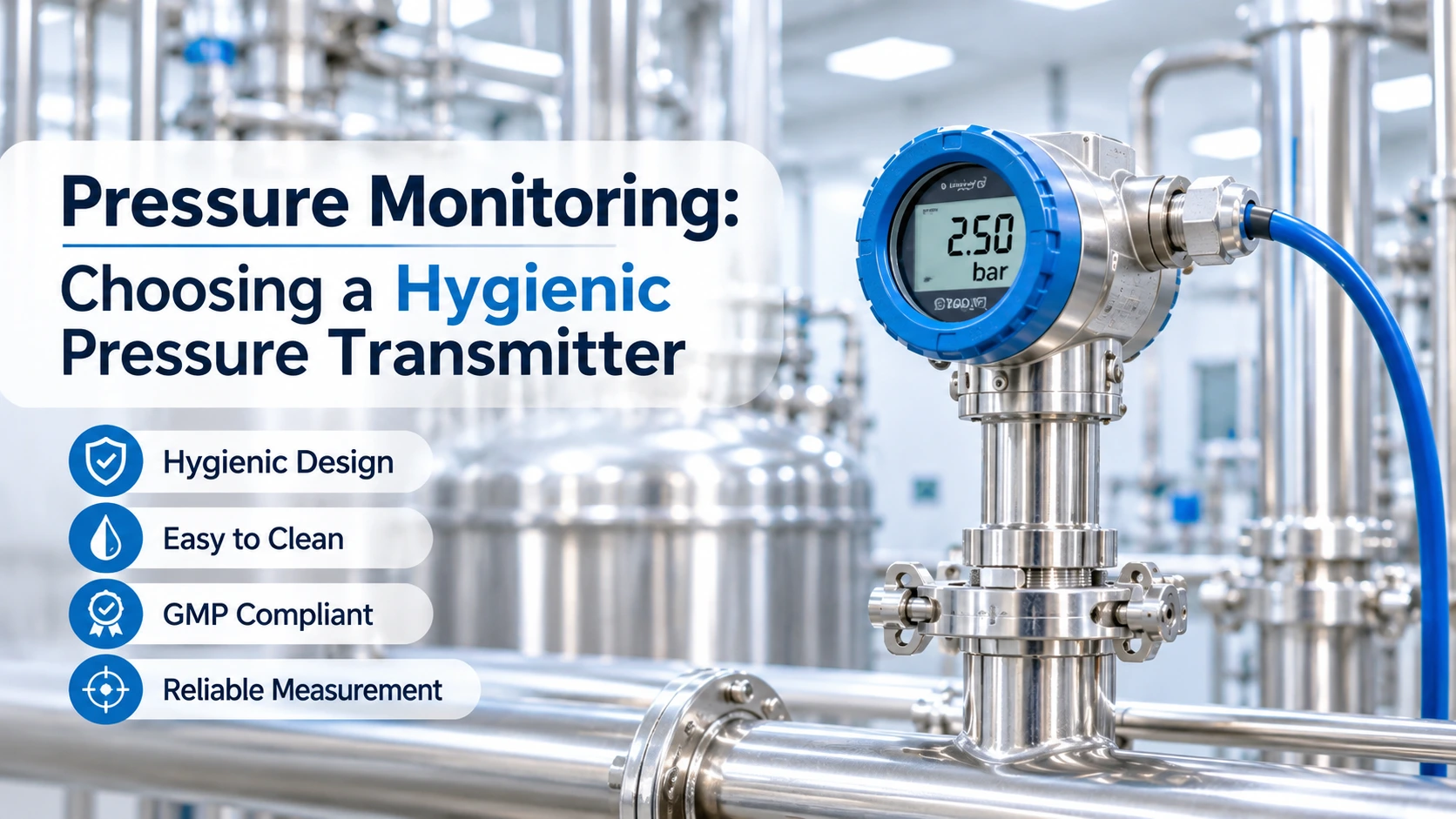
• Flush diaphragmFlush diaphragm with no cavity for product to settle in.
• Tri-clamp connection sized to the line.
• Fill fluid: food-grade or FDA-compliant, or a fill-fluid-free sensor so a diaphragm failure can't contaminate product.
• SIP rating, with a cooling element if the process or steam temperature exceeds the electronics' limits.
• Long-term stability. Low drift means fewer calibration surprises.
• Certificates for materials and calibration, supplied with the unit.
Here's a practical example. On a filter train, a slow creep in differential pressure is your early warning that a filter is loading up. For that duty, stability matters more than a headline accuracy figure.
In a saturated-steam sterilizer, pressure and temperature should agree with each other. A drifting transmitter breaks that agreement and can make a perfectly good cycle look suspect on paper.
Level Monitoring: Picking a Sanitary Level Transmitter
Pharma tanks range from WFI storage to agitated mixing vessels and bioreactors. Each throws its own problems at a sensor: agitators, foam, CIP spray patterns and pressurized or vacuum headspace.
Your main options
• Hygienic hydrostatic: a flush-diaphragm sensor at the tank bottom. Simple and drainable, but closed vessels need headspace pressure compensation.
• Non-contact radar: nothing touches the product. Well suited to storage and large mixing tanks, though agitator blades can create false echoes.
• Guided wave radar: works with a smooth, polished probe. Check for coating and make sure the probe can be cleaned.
• Weighing with load cells: common for bioreactors and mixers. It ignores foam completely, but piping must not restrain the vessel.
Take a WFI storage tank as an example. A radar unit measuring from the top avoids any penetration below the liquid line, which removes a potential leak path and a cleaning headache.
Point detection
For high and low alarms, overfill protection and dry-run protection, a vibrating fork switch with a polished, drainable design does the job. Choose one with hygienic certification and a tri-clamp fitting.
Foam is normal in bioreactors, so avoid methods that depend on a clean liquid surface. For more on matching technology to the medium, see [Link to related post: how to select level measurement instrument].
Pharma Flow Measurement That Survives Audits
Pick the flowmeter by the liquid and the duty, not by habit. This quick guide covers the common applications.
Application | Common choice | Watch out for |
Dosing, filling and formulation | Coriolis | Pick a drainable hygienic design; high mass accuracy and density output |
CIP supply and return | Electromagnetic | Conductive cleaning solutions suit it; check liner and temperature |
WFI and purified water loops | Ultrasonic or Coriolis | Very pure water can fall below the conductivity many electromagnetic meters need |
Clean steam | Vortex | Confirm pressure and temperature ratings and condensate handling |
Compressed air and nitrogen | Thermal mass | Measures mass flow directly; verify calibration matches your gas |
For filling, a Coriolis meter reads mass directly. Changes in temperature or density won't skew the dose the way they can with a volumetric meter.
Mind the water
This catches people out. Water for injection and purified water are deliberately low in conductivity, and electromagnetic meters depend on conductive liquid. Check the meter's minimum conductivity before you assume it will work.
Installation counts as much as the meter
Orient the meter so it drains, avoid air pockets and respect the manufacturer's straight-run requirements. A perfect meter in a bad pipe layout still gives a bad reading.
GMP Compliant Instrumentation: Calibration, Documentation and Validation
An accurate instrument isn't enough. You have to prove it, and that proof feeds into your DQ, IQ, OQ and PQ stages.
Documents to request before you buy
• Material certificates (EN 10204 3.1) for wetted parts
• Surface finish reports for product-contact surfaces
• USP Class VI or FDA statements for elastomers
• Declarations on animal-derived materials (TSE/BSE), where required
• Calibration certificates with as-found and as-left data, traceable to national standards (NABL-accredited labs under ISO/IEC 17025 in India)
• Data sheets, drawings, manuals and FAT records
Ask for these at the quotation stage. Chasing a missing 3.1 certificate after the instrument is installed can mean pulling it out, or worse, a rejection during IQ.
Calibration habits that hold up in an audit
• Tag every instrument and keep it in an asset register.
• Classify each as GMP-critical or non-critical.
• Set intervals by risk and observed drift, not by tradition.
• Record as-found and as-left readings every time.
• If a critical instrument is found out of tolerance, assess the impact on every batch made since its last good calibration.
Instrumentation for Pharmaceutical Plants: Your Takeaway
Specify hygiene, cleaning tolerance and documentation together, not one after another. That single habit prevents most of the rework teams face during qualification.
The right instrumentation for pharmaceutical plants is as much about proof as performance. For deeper guidance on validation of instruments with software, ISPE's GAMP 5 materials are the authority to check.
Planning a new line or a revalidation? Send our team at Kuncham Controls your instrument list and we'll help you match each tag to the right hygienic device and documentation package.
Frequently Asked Questions
Why does pharmaceutical instrumentation need different specifications than general industry?
Pharma instruments must be cleanable, drainable and able to survive sterilization, and they come with certified materials and traceable documents. Because a failure can affect patient safety and regulatory compliance, GMP demands calibration records and proven performance, not just accuracy.
What type of pressure transmitter is suitable for pharmaceutical applications?
A hygienic pressure transmitter with a flush diaphragm, tri-clamp connection and 316L wetted parts is the usual choice. Make sure it's rated for SIP temperatures, uses a food-grade fill fluid or no fill fluid, and ships with material and calibration certificates.
How is level measurement handled differently in pharmaceutical tanks?
Pharma tanks need crevice-free methods that can be cleaned in place. Hygienic radar, flush-diaphragm hydrostatic sensors and load cells are common, while vibrating fork switches handle alarms. Foam, agitators and CIP spray patterns often decide the final choice.
Are calibration and documentation more critical in pharmaceutical instrumentation?
Yes. Under GMP, you have to demonstrate that an instrument is accurate, not just assume it. Traceable calibration, as-found and as-left records and defined intervals for critical instruments are expected, and auditors will ask to see them.
Can Kuncham Controls provide documentation to support pharma plant validation?
Kuncham Controls can support validation with documentation such as material certificates, calibration certificates, data sheets and manuals. The exact set depends on the instrument and your project, so share your validation requirements early and the team will confirm what's available.