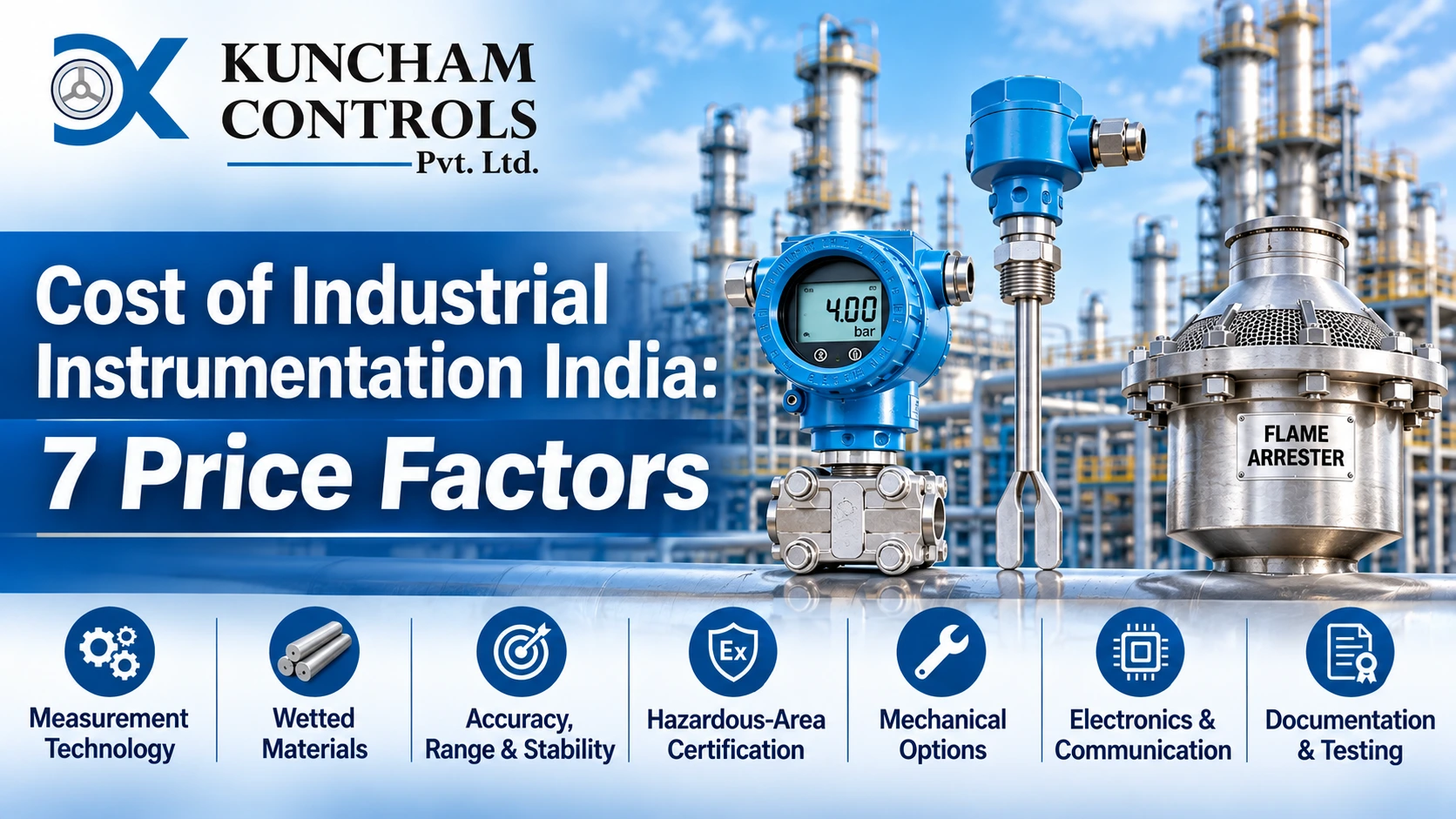
The cost of industrial instrumentation India buyers pay comes down to seven things: measurement technology, wetted materials, accuracy, hazardous-area certification, mechanical options, electronics and documentation. Order quantity and where the product is made then move the final figure up or down.
That's why two quotes for "a pressure transmitter" can sit far apart. One vendor priced a basic 316L unit. The other quoted Ex-certified, with a remote seal and a calibration certificate. Both were honest. They just weren't the same product.
This guide breaks down what moves the price of transmitters, level switches and flame arresters, and how to budget without paying for specs you don't need.
Cost of Industrial Instrumentation India: The Seven Big Price Drivers
Whether you're buying a transmitter or a flame arrester, the same levers decide industrial instrumentation pricing. Check each one before comparing quotes.
1. Measurement technology. A simple float or pressure-based device costs far less than radar, Coriolis or a heat-absorbing detonation arrester. Complexity costs money.
2. Wetted materials. 316L stainless is the common baseline. Hastelloy, Monel, titanium, tantalum or PTFE lining can multiply the price of the parts that touch your process.
3. Accuracy, range and stability. Tighter accuracy and better long-term stability need better sensors and more calibration effort.
4. Hazardous-area certification. Flameproof, intrinsically safe and SIL-rated versions add testing, design constraints and paperwork.
5. Mechanical options. Remote seals, capillaries, special flanges, extension lengths and special coatings all add cost.
6. Electronics and communication. Basic 4–20 mA is cheaper than HART, fieldbus or wireless with local displays.
7. Documentation and testing. Material certificates, calibration certificates, hydro tests, inspection and warranty all sit inside the price.
A quick map of where the money goes
Instrument | Biggest price drivers | Cost-saving direction |
Pressure transmitter | Remote seals, exotic diaphragm materials, Ex certification, accuracy class | Standard 316L, direct mount, general-purpose approval where the area allows |
Level switch | Technology type, probe length, material, Ex and SIL approvals | Simple technology in clean, forgiving duties |
Flame arrester | Size, detonation rating, element material, gas group, certification | Right-sized deflagration unit for the actual hazard |
One habit pays off quickly. Ask each supplier to price options separately: certificate, display, extra material, remote seal. You'll see exactly where one quote is padded and where another is missing something.
Pressure Transmitter Price Factors in Detail
Pressure transmitters look similar from outside, which makes price differences feel arbitrary. They aren't.
The base unit versus the options
The base transmitter, with a standard diaphragm and a basic output, is the cheapest part of the order. Each choice after that stacks on top: Hastelloy diaphragm, HART, display, Ex housing, calibration certificate. These factors affecting transmitter price compound, so a loaded specification can cost a multiple of the base unit.
Remote seals: the big multiplier
When the process is hot, corrosive, viscous or hygienic, you may need a diaphragm seal and capillary system. That assembly can cost more than the transmitter itself, and it adds installation and calibration work.
Range and accuracy
Buying a range far larger than you need hurts accuracy at working pressures, while demanding extreme accuracy for a utility line wastes budget. Pick a range with sensible margin over your normal and maximum pressure, and match the accuracy class to what the loop really needs.
Stability matters here too. A transmitter with better long-term stability costs more upfront, but it can stretch calibration intervals and save maintenance hours later.
Consider an illustration. Quote the same plain gauge-pressure transmitter twice: once as a general-purpose 316L unit, and once with flameproof approval, a Hastelloy diaphragm and a remote seal. The second quote isn't padded. It's a different instrument.
Level Switch Cost India: What Separates Cheap From Costly
Technology sets the starting price
Float switches and simple conductive probes sit at the economical end. Vibrating fork and capacitance switches cost more, but they handle viscous, foamy or changing media without constant adjustment. [Link to related post: tuning fork level switch applications]
What pushes level switch cost up
• Wetted material: 316L, Hastelloy or PTFE-coated probes for aggressive media.
• Extension length: longer probes or fork extensions cost more and need support.
• Temperature and pressure rating: high-rated versions use better seals and materials.
• Approvals: Ex certification and SIL suitability for overfill protection.
• Output type: relay, PNP or NAMUR options differ in electronics cost.
Think about what the switch actually protects. A switch that guards a day tank against an overflow annoys you when it fails. One guarding a flammable storage tank can become an incident, and the specification should reflect that.
A simple rule helps. For a water sump or a utility tank, a cheaper switch is usually fine. For overfill protection on a flammable-liquid tank, the certified, tested option earns its price.
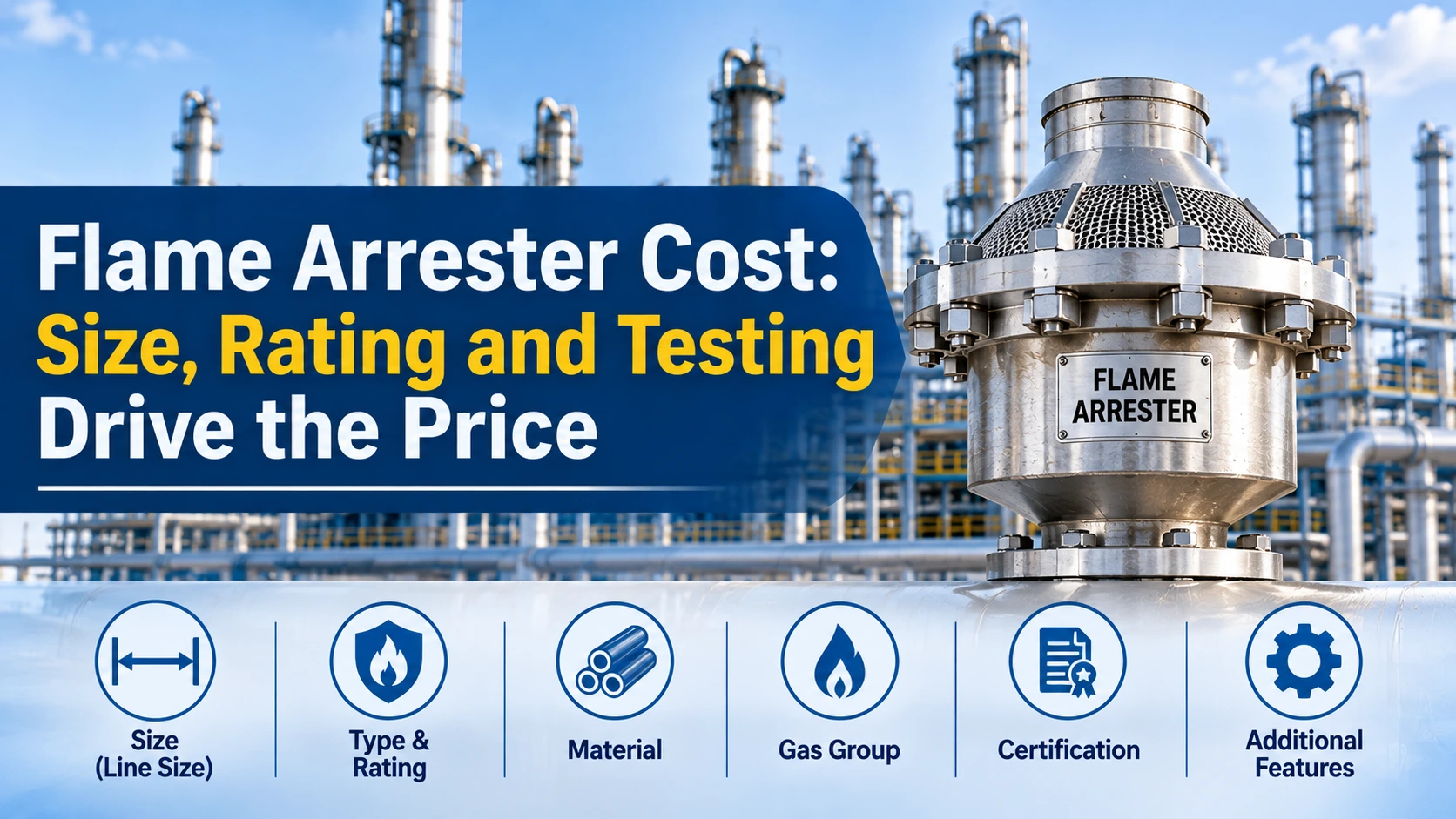
Flame Arrester Cost: Size, Rating and Testing Drive the Price
A flame arrester is a safety device, so you're partly paying for proof that it works under test conditions. That proof is built into the price.
Type and rating
Deflagration arresters protect against flame fronts that travel at subsonic speed. Detonation arresters must handle shock waves and are built heavier and tested harder, so they cost more. Choose the protection level your pipework and gas actually need, not the highest one on the catalogue.
Size and materials
• Line size: larger bodies and elements use more metal and machining.
• Body and element material: carbon steel, stainless steel or alloys, depending on the medium.
• Extras: heating jackets, drain points or integrated pressure and vacuum relief valves.
Gas group and certification
Gases with narrower safe gaps, such as hydrogen, demand tighter element design than propane-class gases. Testing and certification, including ATEX against EN ISO/IEC 80079-49 (which replaced EN ISO 16852) and statutory approvals in India, add further cost.
Location matters as well. An end-of-line arrester on a tank vent and an inline arrester on a process pipeline face different conditions, so they're designed, tested and priced differently.
Flame arrester cost also varies with documentation, so ask exactly what test reports and certificates come with each quote.
Indian Manufacturer, Imported Brand and Order Quantity
Does buying from an Indian manufacturer cut the cost?
Often, yes, but check how and why. Local manufacturing can reduce freight, import duty exposure and lead times, and it makes spares and service easier. Indian manufacturers typically offer easier customisation too.
Still, compare like for like. Ask which certifications apply, where critical sensors come from and what support is on offer. The cheapest unit isn't cheaper if its approvals don't cover your area.
Lead time deserves a line in the budget too. An imported part stuck at customs or waiting for a shipment can hold up a shutdown, and that delay has its own price.
How order quantity changes the price
Larger orders usually lower the per-unit price because setup, testing and freight are spread across more pieces. Standardising on fewer models helps even more, since batch production runs on repeatable specifications.
There's a catch. A big order of a custom specification doesn't earn the same discount as a standard model. And a framework agreement with scheduled call-offs can secure better pricing without tying up cash in stock.
Budgeting for Industrial Instruments: Cheap Now or Cheap Later?
The purchase price is one part of the story. Installation, calibration, spares, downtime and replacement make up the rest. An instrument that fails in a year costs more than one that quietly runs for ten.
A budgeting routine that works
8. Define the must-have specs per tag: range, materials, certification and output.
9. Send every vendor the same data sheet, so quotes compare like for like.
10. Ask for itemised quotes: instrument, options, certificates, accessories, freight and taxes.
11. Include calibration and spares in the budget from day one.
12. Split critical from routine. Spend on safety and quality loops, and save on forgiving duties.
13. Request quantity-tier pricing to see where discounts begin.
Put plainly, cheap equipment isn't a bargain if it costs you a shutdown. Neither is premium equipment on a duty that never needed it.
Cost of Industrial Instrumentation India: Spend Where It Counts
Knowing what drives the cost of industrial instrumentation India-wide gives you the upper hand in every quote discussion. Match the specification to the risk, compare itemised quotes and think in lifetime cost, not unit price.
For the statutory side of hazardous-area products, check PESO's official website, which is the authority on approvals in India.
Ready to price a project? Send your instrument list to our team at Kuncham Controls and we'll help you build a spec and an itemised quote that make sense.
Frequently Asked Questions
What are the main factors that affect the price of a pressure transmitter?
The main factors are sensor technology, range and accuracy, wetted materials, process connection or remote seals, hazardous-area certification, and output type such as HART. Documentation like material and calibration certificates also adds cost. The more demanding the application, the higher the price.
Why do certified instruments cost more than non-certified ones?
Certification involves design constraints, independent testing, documentation and ongoing quality audits. Certified instruments often use stronger enclosures and tighter manufacturing control. You're paying for proven safety performance, not just the hardware.
Does buying directly from an Indian manufacturer reduce cost compared to imported instruments?
It often does, thanks to lower freight and duty exposure, shorter lead times and easier support. But compare certifications, sensor sourcing and warranty terms before assuming a saving. Make sure the product meets your area's approvals.
How does order quantity affect instrumentation pricing?
Larger orders typically reduce the unit price because setup, testing and freight costs are spread across more units. Standard models get better discounts than custom ones. Framework agreements can secure volume pricing without holding large stock.
Is it more cost-effective to buy cheaper instrumentation upfront or invest in higher-quality equipment?
For critical duties, higher-quality equipment is usually more cost-effective over its life, since failures, calibration drift and downtime cost more than the price difference. For forgiving, low-risk duties, a cheaper instrument is often fine. Judge by total cost of ownership, not purchase price.